

The Jumblies


Lyrics
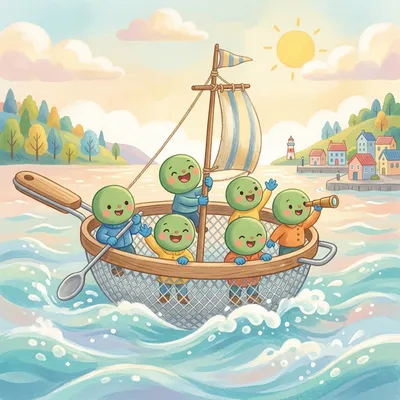
They went to sea in a Sieve, they did,In a Sieve they went to sea:In spite of all their friends could say,On a winter's morn, on a stormy day,In a Sieve they went to sea!And when the Sieve turned round and round,And every one cried, "You'll all be drowned!"They called aloud, "Our Sieve ain't big,But we don't care a button! we don't care a fig!In a Sieve we'll go to sea!"Far and few, far and few,Are the lands where the Jumblies live;Their heads are green, and their hands are blue,And they went to sea in a Sieve.
They sailed away in a Sieve, they did,In a Sieve they sailed so fast,With only a beautiful pea-green veilTied with a riband by way of a sail,To a small tobacco-pipe mast;And every one said, who saw them go,"O won't they be soon upset, you know!For the sky is dark, and the voyage is long,And happen what may, it's extremely wrongIn a Sieve to sail so fast!"Far and few, far and few,Are the lands where the Jumblies live;Their heads are green, and their hands are blue,And they went to sea in a Sieve.
The water it soon came in, it did,The water it soon came in;So to keep them dry, they wrapped their feetIn a pinky paper all folded neat,And they fastened it down with a pin.And they passed the night in a crockery-jar,And each of them said, "How wise we are!Though the sky be dark, and the voyage be long,Yet we never can think we were rash or wrong,While round in our Sieve we spin!"Far and few, far and few,Are the lands where the Jumblies live;Their heads are green, and their hands are blue,And they went to sea in a Sieve.
And all night long they sailed away;And when the sun went down,They whistled and warbled a moony songTo the echoing sound of a coppery gong,In the shade of the mountains brown."O Timballo! How happy we are,When we live in a sieve and a crockery-jar,And all night long in the moonlight pale,We sail away with a pea-green sail,In the shade of the mountains brown!"Far and few, far and few,Are the lands where the Jumblies live;Their heads are green, and their hands are blue,And they went to sea in a Sieve.
They sailed to the Western Sea, they did,To a land all covered with trees,And they bought an Owl, and a useful Cart,And a pound of Rice, and a Cranberry Tart,And a hive of silvery Bees.And they bought a Pig, and some green Jack-daws,And a lovely Monkey with lollipop paws,And forty bottles of Ring-Bo-Ree,And no end of Stilton Cheese.Far and few, far and few,Are the lands where the Jumblies live;Their heads are green, and their hands are blue,And they went to sea in a Sieve.
And in twenty years they all came back,In twenty years or more,And every one said, "How tall they've grown!For they've been to the Lakes, and the Terrible Zone,And the hills of the Chankly Bore;"And they drank their health, and gave them a feastOf dumplings made of beautiful yeast;And every one said, "If we only live,We too will go to sea in a Sieve,To the hills of the Chankly Bore!"Far and few, far and few,Are the lands where the Jumblies live;Their heads are green, and their hands are blue,And they went to sea in a Sieve.
History and Meaning
Everybody in the poem is right except the people who are right. The Jumblies put to sea in a sieve, their friends point out that a sieve is full of holes and they will certainly drown, and the Jumblies go anyway. They are gone for twenty years, they see a great deal, they buy an enormous amount of shopping, and they come back taller than when they left.
Origins
Edward Lear published it in Nonsense Songs, Stories, Botany, and Alphabets in 1871, the same collection that gave us The Owl and the Pussycat. Lear was a working artist rather than a professional writer. He trained as a natural-history illustrator, drawing parrots and other animals with considerable precision, and spent years producing topographical paintings from his travels around the Mediterranean and beyond.
The nonsense was a sideline that began as entertainment for the children of his patron, the Earl of Derby. It has comfortably outlasted the parrots. Lear is said to have held this poem in particular affection among his own work.
Meaning & Interpretation
The refrain does most of the heavy lifting. It arrives at the end of every verse with the same four facts: the lands where the Jumblies live are far and few, their heads are green, their hands are blue, and they went to sea in a sieve. Lear never explains any of it, and the repetition makes the strangeness feel settled rather than surprising.
The geography is invented and deliberately unhelpful. The Jumblies pass through places with names like the Chankly Bore and the Terrible Zone, which sound as though they ought to be findable on a map and are not. Lear reused several of these names across different poems, so his nonsense world has a rough consistency without ever having a location.
Read one way, it is simply a funny poem about odd creatures in unsuitable transport. Read another way, the warnings are the point. The sensible people are certain the voyage will end in disaster, they say so at length, and the poem cheerfully declines to prove them right. Children generally take the second reading without needing it explained.
Why did the Jumblies go to sea in a sieve?
The poem never gives a reason, which is part of the joke. Their friends object that a sieve cannot float and that they will drown, and the Jumblies reply that they do not care and go anyway. Lear leaves the motive blank so the reader can enjoy the recklessness without having to weigh up whether it was justified.
What are the Jumblies supposed to be?
Lear never says. The only description given is that their heads are green and their hands are blue, repeated in the refrain of every verse. They behave like people, they shop and sail and come home, but nothing in the poem settles whether they are meant to be human, and illustrators have been free to invent them ever since.
Where are the Chankly Bore and the Terrible Zone?
Nowhere. Both are Lear's invented place names, built to sound like real features from an atlas or an explorer's account. He used some of the same names in other poems, which gives his nonsense world a loose internal geography, but none of these places corresponds to anywhere on earth.
Is The Jumblies a poem or a song?
Lear published it as a poem in a book titled Nonsense Songs, and its heavy repeated refrain gives it a songlike shape that invites chanting. Several composers have set it to music since, but there is no single traditional tune, so most families read it aloud and let the refrain carry the rhythm.
Related Nursery Rhymes
Lyrics from nurseryrhymes.info