
The Owl and the Pussycat


Lyrics
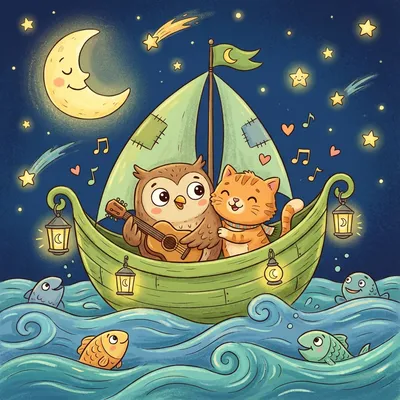
The Owl and the Pussy-cat went to sea In a beautiful pea-green boat,They took some honey, and plenty of money, Wrapped up in a five-pound note.The Owl looked up to the stars above, And sang to a small guitar,"O lovely Pussy! O Pussy, my love, What a beautiful Pussy you are, You are, You are!What a beautiful Pussy you are!"
Pussy said to the Owl, "You elegant fowl! How charmingly sweet you sing!O let us be married! too long we have tarried: But what shall we do for a ring?"They sailed away, for a year and a day, To the land where the Bong-tree growsAnd there in a wood a Piggy-wig stood With a ring at the end of his nose, His nose, His nose, With a ring at the end of his nose.
"Dear Pig, are you willing to sell for one shilling Your ring?" Said the Piggy, "I will."So they took it away, and were married next day By the Turkey who lives on the hill.They dined on mince, and slices of quince, Which they ate with a runcible spoon;And hand in hand, on the edge of the sand, They danced by the light of the moon, The moon, The moon, They danced by the light of the moon.
History and Meaning
Edward Lear wrote "The Owl and the Pussycat" in 1867 to cheer up a friend's sick three-year-old, and it became the best-loved nonsense poem in English. An owl and a cat sail off in a pea-green boat, marry in the land where the Bong-tree grows, and dine on mince with a "runcible spoon," a word Lear invented and never bothered to define.
Origins
Edward Lear wrote the poem in December 1867 to entertain Janet Symonds, the three-year-old daughter of his close friend, the poet and critic John Addington Symonds. At the time, the young girl was ill, and Lear created the whimsical story to cheer her up.
The poem was first published in the United States in the children's magazine Our Young Folks in February 1870. The following year, it was published in the United Kingdom in Lear's collection Nonsense Songs, Stories, Botany and Alphabets in 1871.
Meaning & Interpretation
As a piece of literary nonsense, the poem does not have a deep, hidden symbolic meaning. Instead, it was written purely to delight and amuse children with its fantastical imagery.
However, Lear's work reflects a playful subversion of Victorian societal norms. The marriage between an owl and a cat, two natural predators, is presented as completely harmonious and joyful. The poem also introduced several famous neologisms, most notably the word "runcible," which Lear used in other works but never strictly defined.
Why did Edward Lear write The Owl and the Pussycat?
Lear wrote the poem in 1867 to cheer up Janet Symonds, the young daughter of his friend John Addington Symonds, while she was sick. It was a private gift that was later published for the public in 1870.
What does a runcible spoon mean?
A runcible spoon is a nonsense term coined by Edward Lear. While he did not define it, the word was later adopted in real life to describe a fork-spoon hybrid with a sharp edge, similar to a spork, though in the context of the poem it remains purely whimsical.
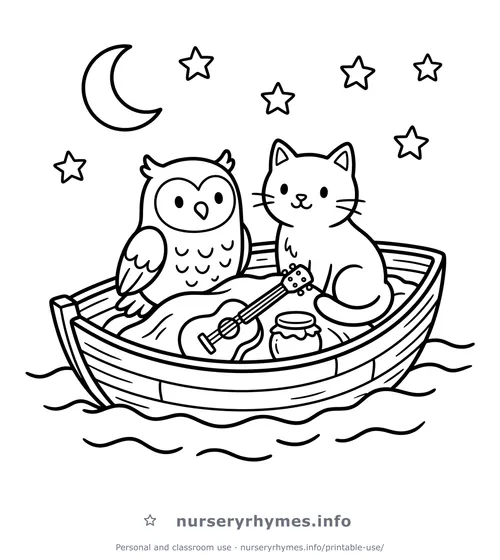
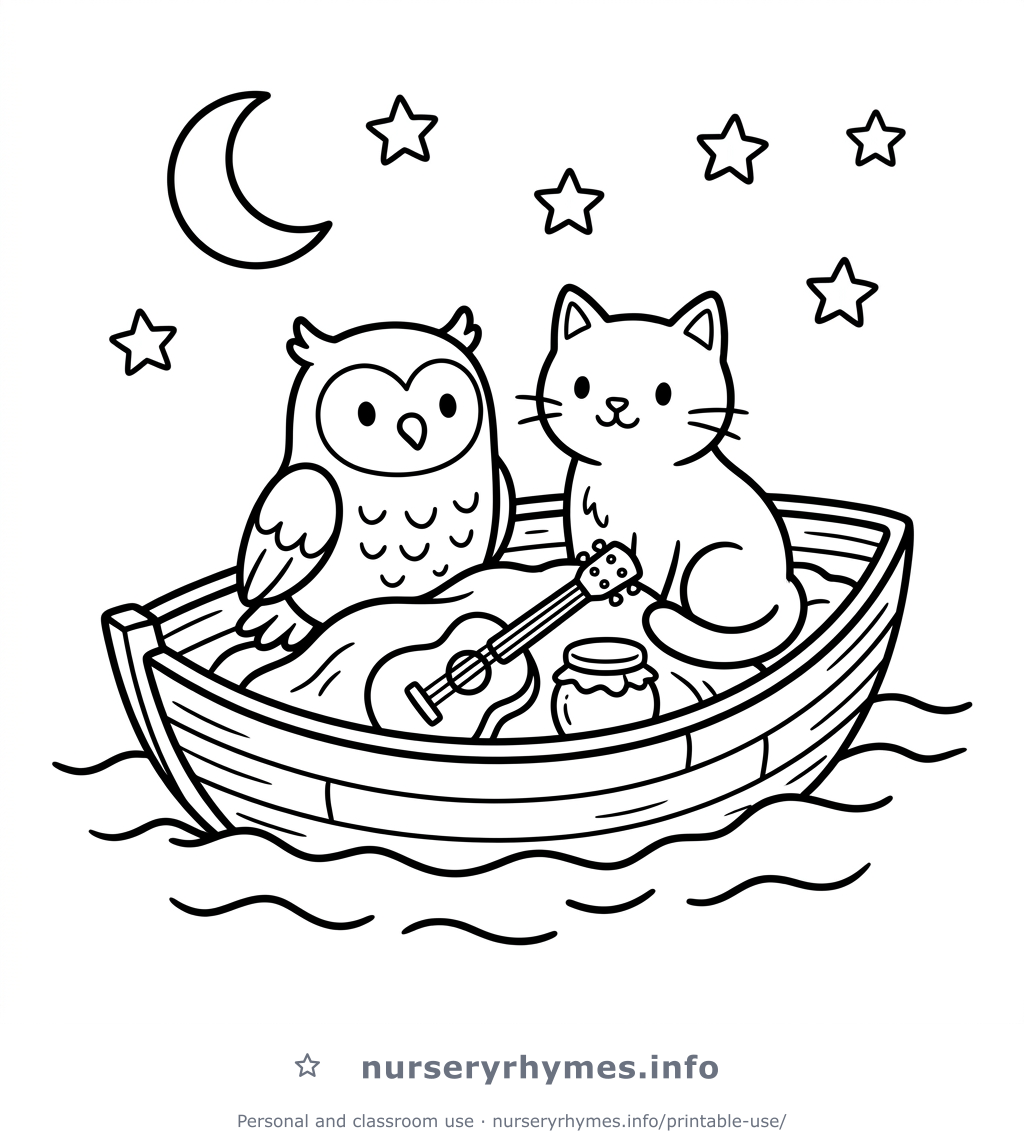
Free Printable Coloring Page
Print this The Owl and the Pussycat coloring sheet for free and let little ones bring it to life with crayons or pencils.
Full-resolution PNG · Fits the paper size selected in your print dialog · Personal and classroom use
Related Nursery Rhymes


Lyrics from nurseryrhymes.info