
The Paw Paw Patch


Lyrics
Where, oh where is pretty little Susie?Where, oh where is pretty little Susie?Where, oh where is pretty little Susie?Way down yonder in the paw paw patch.
One child slips away from the line and hides at the far end of the room.
Come on, boys, let's go find her,Come on, boys, let's go find her,Come on, boys, let's go find her,Way down yonder in the paw paw patch.
The whole line follows the leader, winding around the room to find her.
Pickin' up paw paws, put 'em in your pocket,Pickin' up paw paws, put 'em in your pocket,Pickin' up paw paws, put 'em in your pocket,Way down yonder in the paw paw patch.
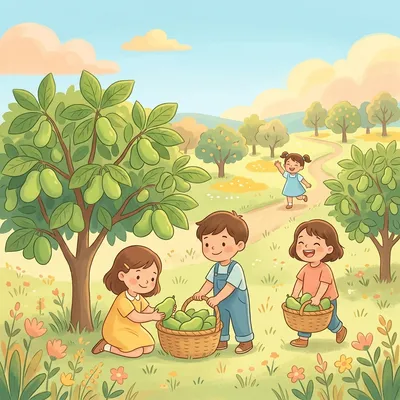
Everyone stoops, gathers imaginary fruit, and drops it in a pocket.
History and Meaning
The pawpaw is a real fruit, and it is probably the most surprising thing in this song. Asimina triloba is the largest edible fruit native to North America, a stubby green thing three to seven inches long with soft golden flesh that tastes something like banana, mango and vanilla at once. It grows wild in the shady bottomlands of the eastern United States. Almost nobody has eaten one. The song outlived the fruit's fame by about a century.
That gap is the reason the words sound like nonsense to modern children. A paw paw patch was once an ordinary place to send a child, the way you might send one to a blackberry hedge.
Origins
"The Paw Paw Patch" is an American play-party song. The earliest documented printing is 1916, in Leah Jackson Wolford's The Play-Party in Indiana, where it appears as "Way Down in the Pawpaw Patch". Wolford developed the book from a master's thesis completed at the University of Chicago in 1915, and the Indiana Historical Commission published it as part of the state's centennial. It gathered fifty-eight games with words, tunes, playing directions and notes.
Folklorists later collected versions across Appalachia, the Midwest, the Southeast and the South, which is roughly the same territory where the pawpaw tree grows. The song is often loosely described as a nineteenth-century Southern piece, but 1916 is the documented floor. Play-party songs travelled by memory for years before anyone wrote them down, so the tune is very likely older than its first printing. How much older, nobody can say from the evidence.
A play-party was a social gathering built to get around a religious objection. In many rural communities dancing was disapproved of, and the fiddle in particular was treated as an instrument of trouble. So young people sang the accompaniment themselves, unaccompanied and with hand-clapping for rhythm, and called the whole thing a game rather than a dance. The name did the diplomatic work: a "play-party" sounded like wholesome recreation, and with no fiddler in the room there was nothing obvious to object to. The form explains the song. The words are simple and endlessly repeated because the singers were also the dancers and needed something they could keep going while moving.
Meaning & Interpretation
There is no story here beyond the errand. Susie has gone to the pawpaw patch, the others go after her, and everyone picks fruit. Names get swapped freely from group to group, and "boys" often becomes "girls" or "children" depending on who is playing.
What the song preserves is a piece of everyday knowledge that has since disappeared. Pawpaws ripen in late summer and early autumn and drop when they are ready. Gathering them was a normal seasonal chore, and putting them in a pocket is exactly what you would do with a fruit picked off the ground. The line is practical, not fanciful.
What is a pawpaw?
A pawpaw is the fruit of Asimina triloba, a small understory tree native to the eastern United States. It is the largest edible fruit native to North America, growing three to seven inches long, with custard-textured golden flesh and large dark seeds. The taste is usually described as a blend of banana, mango and vanilla, which earned it the nickname "poor man's banana". The tree is the only temperate member of the Annonaceae, the custard apple family, whose other relatives are tropical.
Why can't you buy pawpaws in a supermarket?
Because the fruit will not survive the trip. Ripe pawpaws bruise, tear and break down within about two or three days at room temperature, or five to seven days refrigerated. That is far too short for commercial packing, shipping and shelf display, so the pawpaw never became a market crop despite growing readily across a large part of the country. It stayed a fruit you ate near the tree it fell from, which is why a food once common enough to sing about is now unfamiliar.
What was a play-party?
A play-party was a social dance-game gathering held in places where dancing and fiddle music were disapproved of on religious grounds. Participants sang the music themselves, without instruments, clapping the beat and performing movements that matched the words. Calling the events games and plays rather than dances made them acceptable, and the songs supplied both the rhythm and the instructions for the figures.
How do you play The Paw Paw Patch?
Children stand in two facing lines, or a single line with a leader at the head. During the first verse one child, the "Susie" of the song, slips away and hides at the far end of the playing space. On the second verse the rest of the line follows the leader, winding around the room until they find her. On the third verse everyone stoops to gather imaginary pawpaws from the ground and mimes dropping them into a pocket. A new child is chosen and the game starts again.
Related Nursery Rhymes
Lyrics from nurseryrhymes.info