

The Purple Cow


Lyrics
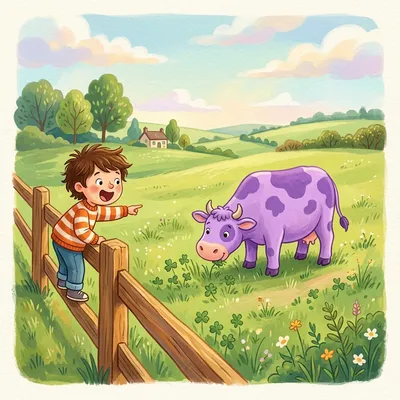
I never saw a Purple Cow,I never hope to see one;But I can tell you, anyhow,I'd rather see than be one.
History and Meaning
Four lines, published in a San Francisco magazine in 1895, made Gelett Burgess famous and then followed him around for the rest of his life. He grew so tired of being introduced as the Purple Cow man that he wrote a second verse telling people to stop quoting the first one. Both are now quoted together.
Origins
Burgess founded The Lark, a small, deliberately odd San Francisco literary magazine, and ran the verse in its first issue in May 1895. The Lark lasted two years. The Purple Cow outlived it by more than a century.
By 1897 Burgess had had enough. He published a follow-up, usually printed under the title "Confession: and a Portrait Too, Upon a Background that I Rue":
Ah, yes, I wrote the "Purple Cow" I'm Sorry, now, I wrote it! But I can tell you Anyhow, I'll Kill you if you Quote it!
Burgess had a second, quieter claim on the language. He coined the word blurb in 1907, on a mock dust jacket he designed for one of his own books, and the word stuck.
Meaning & Interpretation
The joke is a small logical swap. The first two lines set up what sounds like a straightforward statement about never having seen a purple cow. The last two turn it into a comparison nobody asked for, between seeing one and being one, and firmly picks a side.
Children usually laugh before they can explain why. The verse works on the same principle as a good riddle: it hands you a sensible-sounding sentence and then quietly changes what it is about halfway through.
Who wrote The Purple Cow?
Gelett Burgess, an American humorist and illustrator, published it in 1895 in the first issue of his own magazine The Lark. He was trained as an engineer and had worked as a draughtsman before turning to writing.
Why did Gelett Burgess write a poem attacking his own poem?
The verse became so widely repeated that it overshadowed everything else he produced, and people quoted it at him constantly. Around 1897 he published a four-line reply saying he was sorry he had written it and threatening anyone who quoted it. The sequel is a joke about his own fame rather than genuine bad temper.
What does "I'd rather see than be one" mean?
He is saying that given a choice between looking at a purple cow and being a purple cow, he would pick looking. The line is funny because no one was offering that choice, and because it treats an imaginary animal as a real career risk.
Related Nursery Rhymes



Lyrics from nurseryrhymes.info