

There Was a Little Man


Lyrics
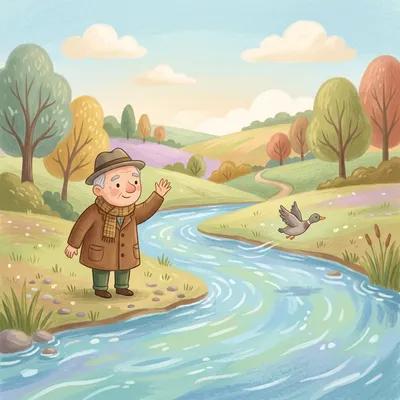
There was a little man,And he had a little gun,And his bullets were made of lead, lead, lead;He went to the brook,And he shot a little duck,And he shot it right through the head, head, head.
He carried it homeTo his old wife Joan,And bade her a fire to make, make, make;To roast the little duckHe had shot in the brook,And he'd go and fetch the drake, drake, drake.
History and Meaning
The oldest printed version of this rhyme does not say bullets. It says "the Ball was made of Lead", singular, which is what a muzzle-loading gun of the 1740s actually fired. The rest of the story is plain country business: a man shoots a duck at the brook, brings it home for his wife Joan to roast, and goes back for the drake. What makes the rhyme worth attention is not the plot but the book it survives in, a volume roughly three inches tall that is the earliest surviving collection of English nursery rhymes anywhere.
Origins
The rhyme appears as "There was a little Man" in Tommy Thumb's Pretty Song Book, published in London in May 1744 by Mary Cooper, with the compiler credited under the pen name Nurse Lovechild. It sits on pages 43 and 44. The 1744 wording differs from the modern one in small ways that are easy to miss: the man shoots "at a Duck" and hits "her upon the Head", then goes home to bid Joan "a good fire make, To roast the Duck, That swam in the Brook", and offers to fetch her the drake. The tripled words at the end of each line ("lead, lead, lead") are not there. They were added later by singers and editors who wanted a refrain.
The book itself is a small marvel of printing. It measures about three inches by one and three quarters, alternates its openings in red and black ink, and was produced from copper plates with the text stamped in by punches, a method borrowed from map and music printing rather than from ordinary bookwork. It held around forty rhymes, among them "Baa Baa Black Sheep" and "Hickory Dickory Dock". Only the second volume survives. The first is lost entirely. For a long time the British Library held the sole known copy, until a second surfaced in 2001 and sold for 45,000 pounds; it now belongs to the Cotsen Children's Library at Princeton.
Tommy Thumb's was a commercial novelty for customers who could afford a bound curiosity. Most rhymes reached print by a rougher road, through chapbooks, and the two channels ran side by side for a century. Folklorists index this rhyme as Roud 1289.
Meaning & Interpretation
There is no buried allegory here, and collectors who have looked for one have come back empty. Shooting waterfowl for the pot was routine work in the eighteenth century, mentioned in the rhyme the way any household chore would be, and then the verse moves straight on to the fire and the roasting.
What the rhyme is really doing is teaching the shape of a song. The structure is built on paired short lines with a hard rhyme landing at the end of each unit: gun and lead, brook and head, home and Joan. The detail about the drake rewards a listener who is paying attention. The bird shot in the older text is female, so the drake is the male still out on the water, and the little man is promising to go back for a second bird. Modern versions blur this by making the first duck genderless, which leaves the last line looking like a stray thought rather than the small joke it once was.
What is a chapbook?
A chapbook was a cheap, pocket-sized booklet, usually made from a single sheet folded down into eight, sixteen, or twenty-four pages, sold for a penny or so and rarely for more than sixpence. The name comes from the chapmen, the pedlars who carried them from village to village along with buttons, ribbons, and other small goods. Chapbooks carried ballads, folk tales, riddles, prophecies, religious tracts, and nursery rhymes, and by the eighteenth century they had overtaken the broadside ballad as the most widely read street literature in Britain. They were the mass-market paperbacks of their day, printed badly on poor paper and read until they fell apart, which is why so few survive. Gammer Gurton's Garland, first issued as a chapbook in 1784, put a large number of familiar rhymes into print for the first time.
Is this the same rhyme as "There was a little man and he wooed a little maid"?
No, though the two are constantly confused and sometimes printed together. The courting song begins with almost the same line and uses the same tripled-word ending ("will you wed, wed, wed", "turn the spit, spit, spit"), but it tells a separate story in which a maid answers a proposal by asking what the couple will actually live on. Sabine Baring-Gould printed it as its own numbered item in his 1895 collection. Shared opening lines and shared refrain patterns were common currency among rhyme makers, so overlap of this kind says little about a shared source.
Why do the lines repeat words like "lead, lead, lead"?
The repetitions are a singing device, not part of the original text. The 1744 printing has none of them. They developed as the rhyme passed through oral use and later songbooks, where a tripled last word gives children something easy to join in on and pads each line out to a steadier beat. Several other nursery songs picked up the same habit in the same period.
Related Nursery Rhymes





Lyrics from nurseryrhymes.info