
There Was a Princess Long Ago
Lyrics
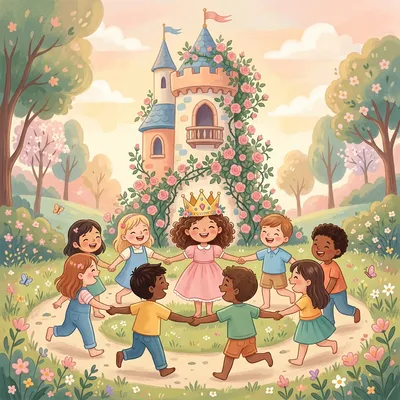
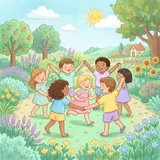
All join hands and circle round one child, who stands in the middle as the princess.
There was a princess long ago,Long ago, long ago,There was a princess long ago,Long, long ago.
The circle raises joined hands high to make the tower walls.
And she lived in a big high tower,A big high tower, a big high tower,And she lived in a big high tower,Long, long ago.
One child steps in as the fairy and waves a wand over the princess.
One day a fairy waved her wand,Waved her wand, waved her wand,One day a fairy waved her wand,Long, long ago.
The princess lies down in the middle and closes her eyes.
The princess slept for a hundred years,A hundred years, a hundred years,The princess slept for a hundred years,Long, long ago.
The circle creeps inward with arms waving overhead like branches.
A great big forest grew around,Grew around, grew around,A great big forest grew around,Long, long ago.
A child chosen as the prince rides round the outside of the ring.
A handsome prince came riding by,Riding by, riding by,A handsome prince came riding by,Long, long ago.
He swings an arm to cut the branches, and the circle drops its hands and opens.
He took his sword and chopped it down,Chopped it down, chopped it down,He took his sword and chopped it down,Long, long ago.
The prince takes the princess by the hand and she stands up.
He took her hand to wake her up,Wake her up, wake her up,He took her hand to wake her up,Long, long ago.
Everyone joins hands again and skips round, or claps and cheers.
So everybody's happy now,Happy now, happy now,So everybody's happy now,Happy now.
History and Meaning
This is Sleeping Beauty turned into a piece of playground theatre. Nine verses, each with one action, and by the end of them a group of children has staged an entire fairy tale without a word of spoken dialogue. The tune barely changes from verse to verse, which is the point: the words tell you what to do next, and the youngest player in the ring can follow along by copying whoever is nearest.
Despite the opening line, the game is not medieval and not ancient. It comes out of the German kindergarten movement of the nineteenth century.
Origins
The English song is a version of the German singing game "Dornroschen war ein schones Kind", Dornroschen being the German name for the Sleeping Beauty of the Grimm brothers' tale. German song scholarship credits the text to Margarete Loffler, a teacher in Dresden, who wrote it in the 1890s at the request of a seminary teacher named Adolf Netsch. It was printed in Franz Magnus Bohme's large collection "Deutsches Kinderlied und Kinderspiel", published by Breitkopf and Hartel in Leipzig in 1897. Loffler fitted her new fairy-tale words to an older folk melody that had carried quite different verses, among them "Mariechen sass auf einem Stein".
That places the song firmly in the era of Friedrich Froebel's kindergarten. Froebel (1782 to 1852) built organised singing and movement games into early years teaching, and his book of mother songs and nursery songs, "Mutter- und Koselieder" of 1843, went through many editions and was translated into English. German kindergarten teachers carried the method to Britain, the United States and elsewhere through the second half of the century. Songs written for that classroom then escaped into playgrounds, and a couple of generations later they were being collected as folklore. "There Was a Princess Long Ago" is one of the clearest cases: a composed nineteenth-century teaching song that now looks and behaves exactly like an old traditional game.
No single documented moment marks its arrival in English. It was circulating in British and Commonwealth schools through the twentieth century, and the English words vary from playground to playground, which is what happens to any song that travels by ear.
Meaning & Interpretation
The song is a compressed retelling of "Little Briar Rose", the Grimm version of Sleeping Beauty. The tower, the fairy's wand, the hundred-year sleep, the thorn forest and the prince who cuts through it are all in the tale. What the game adds is a body for each of them. The ring of held hands becomes the tower, then the forest, then the wedding party, and the same children play all three without leaving their places.
For teachers this is why the song has stayed useful. It gives every child something to do at the same moment, needs no props, and hands out three solo parts, princess, fairy and prince, that rotate to a new set of children each time through. The final verse exists mainly so that everybody is standing, holding hands and moving again before the song stops.
Is the game as old as it sounds?
No. "Long, long ago" refers to the story, not to the song. The game descends from "Dornroschen war ein schones Kind", written in the 1890s for German kindergartens and printed in 1897, so it is a nineteenth-century classroom invention rather than a survival from the Middle Ages. The fairy tale it dramatises is older, but the ring game around it is not.
How do you play There Was a Princess Long Ago?
Pick one child to be the princess and stand her in the middle. Everyone else joins hands and circles her while singing. Raise the joined arms for the tower, send in a fairy to wave a wand, let the princess lie down to sleep, then close the ring inward with waving arms for the forest. A prince rides round the outside, chops through the branches so the ring opens, and takes the princess by the hand to wake her. Everybody circles again for the last verse.
What other ring games are like it?
Go In and Out the Window uses the same held-hands circle with arches to duck through, and In and Out the Dusty Bluebells weaves one player through the ring while the rest keep the arches up. Both build a chain of players in the way this game builds a cast, and both work with the same age group.
Related Nursery Rhymes
Lyrics from nurseryrhymes.info