

In and Out the Dusty Bluebells

Lyrics
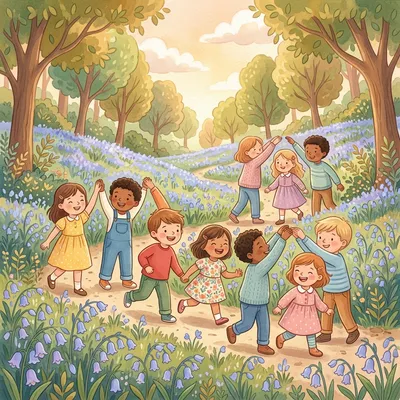
The children make a ring and raise their joined hands to form arches. One child weaves in and out through them.
In and out the dusty bluebells,In and out the dusty bluebells,In and out the dusty bluebells,Who will be my master?
The weaver stops behind one child and taps that child's shoulders in time.
Pitter patter, pitter patter on my shoulder,Pitter patter, pitter patter on my shoulder,Pitter patter, pitter patter on my shoulder,You will be my master.
The tapped child holds on behind, and the pair weave off together. Repeat until nobody is left holding up an arch.
History and Meaning
A ring of children lift their joined hands into arches, and one player threads through the gaps while everyone sings. At the end of the verse the weaver stops behind whichever child she has landed on, drums on that child's shoulders through the "pitter patter" lines, and the tapped child takes hold behind her. Now there are two weavers. Then three, then four. The ring shrinks as the chain grows, and the game finishes when the last pair of arms comes down and there is nothing left to weave through.
The bluebells are the arches. Raised arms hanging together look like the drooping heads of the flower, and the child pushing past them is doing what anyone does walking through a wood in May, knocking the dust off as she goes.
Origins
The earliest firm records of this game are Scottish, and they are late. In 1949 pupils at Norton Park School in Edinburgh were recorded on disc singing it. The following spring, teachers at the same school, led by the science master James T. R. Ritchie, spent the Easter holiday filming around sixty of their pupils playing street games at Easter Road, the Canongate, Calton Hill, the West Bow and the Grassmarket. The resulting eighteen-minute film, The Singing Street, was first shown in 1951. The game appears twice in its twenty-one songs, once as "Bluebells and dummie shells" and once as "The Dusting Bluebells". Alan Lomax recorded Norton Park children during his own Scottish collecting trip in 1951, and those performances were later issued as Singing in the Streets: Scottish Children's Songs.
Iona and Peter Opie set it among the arch and weaving games in The Singing Game (1985), the volume of their survey devoted to what children sing while they play rather than while they skip or count out.
Scotland is where the game is earliest documented, which is not quite the same as saying it started there. Nobody has turned it up in the big Victorian folklore collections, and it is generally taken to have formed in the earlier part of the twentieth century. By the 1960s and 1970s it was ordinary playground property across Britain and Ireland, played mostly by girls, and it thinned out again from the 1990s onward. The name drifted as it travelled: dusty bluebells, dusky bluebells, dusting bluebells, all the same game.
Meaning & Interpretation
"Who will be my master?" is the recruiting line. The weaver sings it as a genuine question to a ring that cannot answer, and then answers it herself with her hands by stopping behind somebody and tapping. The wording sounds backwards, since the weaver appears to be submitting to the child she has picked, but in play the tapped child is the one conscripted. Some groups resolve the oddity by passing the lead forward, so the newest recruit heads the chain on the next round and every player gets a turn at the front.
Explanations tying "master" to Scottish feeing markets, where farm workers hired themselves out for a term, get repeated often but rest on no documented evidence, and the game is too recent for the connection to be likely. Treat it as folklore about folklore.
The structure belongs to a recognisable family. Go In and Out the Window uses the same raised-arm arches and the same weaving path, and Bluebird, Bluebird sends its flyer through identical windows before the shoulder-tapping recruitment. All three run on one mechanism: a circle that turns itself into a gateway, and a soloist who converts players from the ring into followers until the ring is gone.
How do you play it?
Form a circle holding hands, then lift the joined hands high so there is an arch between each pair of children. Pick one child to start. While everyone sings the first verse, that child weaves in and out through the arches, going through one, round the outside of the next, and back in again. On "who will be my master?" she stops behind whoever she has reached. During the "pitter patter" verse she pats that child's shoulders in time with the beat. The tapped child drops out of the ring, holds the weaver's waist or shoulders, and the two of them set off together on the next verse. Each round adds one more child to the chain, so the arches run out and the last player joins the tail.
Why are they called dusty bluebells?
The raised and joined arms of the ring resemble the hanging bells of the flower, and weaving through them suggests brushing through bluebells in woodland and shaking the dust or pollen loose. Groups that sing "dusky bluebells" are describing the shade under the trees instead. Neither wording is more correct than the other.
How many children do you need?
Six is about the minimum for the weaving to feel like anything, since a smaller ring gives too few arches to travel through. Ten to fifteen works best. Above twenty the early rounds get slow for the children still standing with their arms up, so large groups usually split into two rings rather than making one enormous one.
Is it the same game as Go In and Out the Window?
No, though they are close relatives. Go In and Out the Window also has a ring making arches and a soloist weaving through, but it typically ends with the soloist kneeling before a partner or choosing one to face, and the ring stays intact. In this game the ring is consumed. Each round removes a child from the circle and adds her to a growing chain, so the playing space steadily disappears.
Related Nursery Rhymes
Lyrics from nurseryrhymes.info