

In Marble Halls

Lyrics
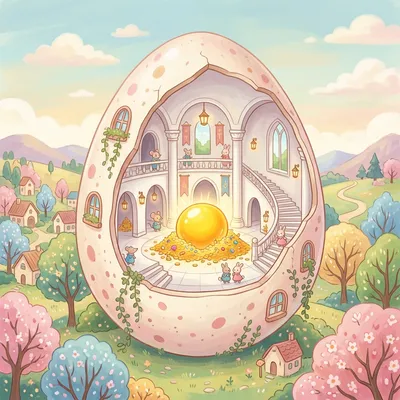
In marble halls as white as milk,Lined with a skin as soft as silk,Within a fountain crystal clear,A golden apple doth appear.No doors there are to this stronghold,Yet thieves break in and steal the gold.
History and Meaning
Six lines, one object, and not a wasted word. "In Marble Halls" is a riddle rather than a song, and it belongs to the small group of nursery puzzles that adults still enjoy long after they know the answer. The pleasure is not in being stumped. It is in going back through the lines afterwards and finding that every single image was accurate all along.
The riddle describes something you have almost certainly held this week. It builds the object from the outside in: first the shell of the thing, then its lining, then what is held inside, then a closing twist about theft that gives the whole puzzle its snap.
Origins
The riddle is long established in English oral tradition and turns up in nursery collections and riddle books under both "In marble halls" and "In marble walls". No firm first printing has been established, and the versions in circulation differ in small ways, which is normal for a text that travelled by word of mouth before anyone bothered to write it down. Some copies say "as white as milk", others "white as milk". Some end with "steal the gold", others with "the gold".
Riddles of this kind are among the oldest things in the English nursery. Old English literature contains a whole book of them, and the medieval and early modern habit of setting puzzles at the dinner table kept them alive for centuries before children's publishers began collecting them. What makes this one unusual is its polish. Many traditional riddles are blunt or lean on a pun. This one is built as a small piece of architecture, complete with halls, a lining, a fountain and a stronghold, and it stays inside that metaphor from the first line to the last.
A close cousin appears in J. R. R. Tolkien's The Hobbit, where Bilbo Baggins poses the riddle "A box without hinges, key, or lid, yet golden treasure inside is hid" during the riddle contest in the dark. Tolkien knew the traditional riddling tradition well, and his version compresses the same object into two lines that the older rhyme spends six on.
Meaning & Interpretation
Every line maps onto one part of the object. The marble halls as white as milk are the shell, hard and pale and smooth. The skin as soft as silk is the thin membrane just inside the shell, the papery layer you peel away when you shell a boiled one. The fountain crystal clear is the white, which really is clear before it is cooked. The golden apple is the yolk, round and set in the middle of that clear liquid.
Then the last two lines change register. Having built a fortress, the riddle points out that it has no doors, no entrance of any kind, and yet thieves get in and take the gold anyway. The thieves are whoever eats it, which is a wry way of admitting that this magnificent stronghold can be defeated by a spoon. Children often reach for a castle or a bank vault before they land on the real answer, and that misdirection is deliberate.
The riddle works well read aloud with a pause before the last couplet. Younger children who cannot solve it usually still enjoy the reveal, because the pieces click into place so cleanly.
What is the answer to the riddle?
An egg. The marble halls are the shell, the silky skin is the membrane inside it, the crystal fountain is the egg white, and the golden apple is the yolk. The stronghold has no doors because a shell has no opening, and the thieves who break in and steal the gold are the people who crack it and eat it.
How old is the In Marble Halls riddle?
Nobody knows precisely. It has been part of English oral tradition for a long time and was printed in nursery and riddle collections once such books became common, but no confirmed first appearance has been pinned down. Riddles like this circulated by speech for years before anyone recorded them, so the printed dates mark when someone wrote it down rather than when it was made up.
Are there other riddle rhymes for children?
Several, and they use the same trick of describing an everyday object as though it were something grand. Little Nancy Etticoat describes a candle as a girl in a white petticoat who grows shorter as she stands. Thirty White Horses turns teeth and gums into horses on a red hill. Arthur O'Bower gives a storm wind the name and manner of a nobleman.
Why is the yolk called a golden apple?
"Golden apple" is doing two jobs. It describes the yolk accurately, since it is round and yellow, and it borrows the language of fairy tale and myth, where golden apples are guarded treasure. That choice sets up the ending, because treasure invites thieves, and the riddle needs thieves for its final line.
Related Nursery Rhymes




Lyrics from nurseryrhymes.info