
Thirty White Horses

Lyrics
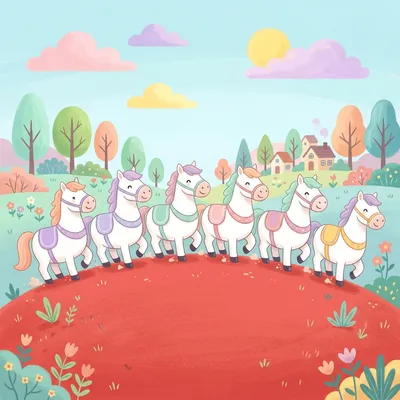
Thirty white horses upon a red hill,Now they champ,Now they stamp,Now they stand still.
History and Meaning
This is a riddle, not a song. Four short lines sketch a picture that makes no literal sense, a troop of white horses standing on a hill that is red, and the whole point is the silence afterwards while the listener turns it over. Nothing in it is decoration. Every noun and every verb is carrying a second meaning, and once the answer arrives the scene snaps into place so neatly that most people feel slightly annoyed they did not get there sooner.
Most readers now meet these lines through J.R.R. Tolkien. In chapter five of The Hobbit, published in 1937, Bilbo Baggins puts a version of this riddle to Gollum during the underground riddle game, and Gollum solves it immediately. Tolkien did not invent it. He was reaching for something already old and already well worn, which is precisely why the scene works.
Origins
The riddle belongs to English oral tradition, and it has moved through nurseries, schoolyards and riddle books for a long stretch of time. No firm first printing has been established for it. That is worth saying plainly rather than filling the gap with a confident-sounding date, which is a common habit in rhyme collections. Riddles of this type travelled by mouth for years before anyone wrote them down, so the earliest surviving printed copy usually records a late stage of the riddle's life rather than its beginning.
What can be shown is that the lines were thoroughly familiar in Britain by the 1930s. Tolkien's own handling is the evidence. His narrator treats the riddle as an old one whose answer Gollum knows as well as the reader does, and that aside only lands if the audience recognises it already. A writer does not build a joke on a riddle nobody has heard.
The English riddle habit it comes out of produced several survivors that are still repeated to children. Little Nancy Etticoat hides a candle behind a description of a small woman in a white petticoat with a red nose that grows shorter the longer she stands. Arthur O'Bower dresses up the wind as a bellowing traveller. All three share the same method: give the object a body, describe its behaviour honestly, and let the disguise do the rest.
Meaning & Interpretation
The misdirection here is built almost entirely out of the word "horses". It pulls the listener outdoors, towards fields and stables and a hillside, and the verbs reinforce it. Champing and stamping are things horses genuinely do, so the picture holds together and gives the mind nowhere uncomfortable to snag.
The colour pairing is the real clue and the reason the riddle has lasted. White objects arranged in a row on something red is a very specific image, and it is doing exact descriptive work rather than sounding pretty. The final line, the sudden stillness, is the third clue: whatever these are, they move in unison and then stop together, which rules out actual animals with minds of their own.
What is the answer to the riddle?
The answer is teeth. The thirty white horses are the teeth themselves, the red hill is the gums they sit in, and the champing and stamping is chewing, all of them working at once and then falling still when the mouth closes. The number varies between versions, and the variation is not sloppiness: thirty-two is the complete adult set, thirty allows for a couple already lost, and four-and-twenty turns up in some tellings as a number English rhyme reaches for by reflex.
Did Tolkien write the thirty white horses riddle?
No. Tolkien used an existing traditional riddle in The Hobbit rather than composing this one. The riddle-game chapter draws on older riddling material generally, including Old English and Old Norse sources, and Bilbo's contributions tend to be the more modern and more domestic ones. The wording differs slightly from the common nursery form. Tolkien has "first they champ, then they stamp, then they stand still", where the traditional version usually repeats "now".
Why are the teeth called horses?
Because the riddle needs a creature that moves in a group, makes a hard mechanical noise, and can be described as standing on a hill without the image collapsing. Horses fit all three. The choice also sets up "champ", a word used of horses working at a bit, which is one of the few verbs that fits both halves of the riddle perfectly.
Related Nursery Rhymes



Lyrics from nurseryrhymes.info