

Who Stole the Cookie from the Cookie Jar?
Lyrics
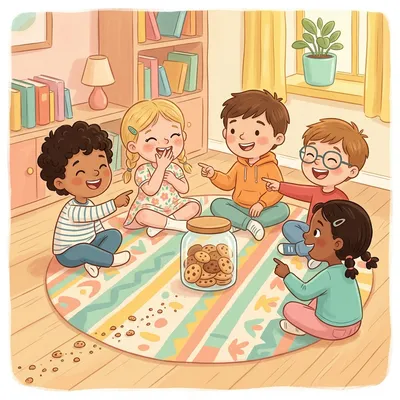
Everyone sits in a circle. Keep a steady beat all the way through: slap your knees, clap your hands, slap, clap.
Group:Who stole the cookie from the cookie jar?
Group:Anna stole the cookie from the cookie jar!
Anna:Who, me?
Group:Yes, you!
Anna:Couldn't be!
Group:Then who?
Anna:Ben stole the cookie from the cookie jar!
Ben:Who, me?
Group:Yes, you!
Ben:Couldn't be!
Group:Then who?
Ben:Sofia stole the cookie from the cookie jar!
And on it goes, around and around, until somebody laughs, loses the beat, or forgets a name.
History and Meaning
Almost every English-speaking child in the last few decades has chanted this one, and nobody can say where it started. There is no known author, no first printing anyone has traced, no collector's name attached to it and no date. It travelled from playground to playground and classroom to classroom on its own, without ever passing through a book on the way, which is exactly why the written record is empty.
What it actually is: a rhythm game with an accusation in it. One child gets blamed for the missing cookie, denies it, blames somebody else, and the blame keeps moving. The words matter far less than the beat underneath them.
Origins
Nothing about the origin of this chant is documented. No first printing has been identified, no folklorist is credited with collecting it in the field, and no date of first appearance has been established. It carries no Roud number and does not appear in the standard reference collections of English-language children's rhymes.
Secondary sources generally assume it is a twentieth-century American playground chant, and that is a reasonable guess given where it is thickest today, but it is a guess rather than a finding. The English-language Wikipedia article on it has carried a citations-needed banner and offers no country, no date and no source.
One story gets repeated often enough that it is worth naming: that the chant began in England as a song about a stolen biscuit and changed to a cookie when it crossed the Atlantic. That story is unproven. Every source that mentions it says so, or fails to cite anything at all. Treat it as folklore about the folklore.
The likeliest explanation for the silence is simply that this is oral material of the least collectable kind. It is not a song, so it escaped the song collectors. It has no fixed text, since half the words are the names of whoever happens to be sitting in the circle. There is nothing stable to write down.
Meaning & Interpretation
The cookie jar is a pretext. The real content of the chant is the difficulty of speaking in time.
The group sets a four-beat pattern, usually knees-clap-knees-clap, and it does not stop. Every line has to land inside that pattern. A child who is accused has to hear their own name, register that it is their turn, say "Who, me?" on the beat, deny it on the beat, and then produce somebody else's name without hesitating. Under that small pressure, children forget names they have known all year. They come in early, or a beat late, or say the name of the person who just accused them.
That is the game, and it is genuinely hard. It also has no built-in ending. There is no last verse and no winner. The chant runs until the rhythm falls apart, which it always does, and the collapse is the punchline everyone is waiting for. Some groups speed up on purpose to bring it about faster.
The accusation itself is doing something too. Being blamed is uncomfortable in real life, and here it is made harmless and passed along like a hot potato. Nobody stays guilty. The blame is off you in four beats.
How do you play it?
Sit the group in a circle and start a steady beat that everybody keeps going the whole time: slap your thighs, clap your hands, slap, clap. Once the beat is solid, the group chants "Who stole the cookie from the cookie jar?" and then names a child: "Anna stole the cookie from the cookie jar!" That child answers "Who, me?", the group replies "Yes, you!", the child says "Couldn't be!", the group asks "Then who?", and the accused child names somebody else. That new child is now the accused, and the same exchange repeats. Nobody stops clapping at any point, and the chant continues around the circle until the beat breaks down.
Where does it come from?
Nobody knows. There is no established first printing, no named collector, no recorded date and no documented country of origin. It is usually assumed to be a twentieth-century American playground chant, but that assumption rests on where the chant is common now rather than on any evidence. The often-repeated claim that it began as an English song about a stolen biscuit has never been supported by a source.
What if a child cannot keep up?
Slow the beat right down before you start, and slow it again if the group is struggling. Younger children often manage the words long before they can fit them to the rhythm, so let the pattern be as slow as it needs to be. It also helps to go around the circle in order at first, so that each child knows their turn is coming, and only switch to free choice of names once everyone is confident.
Are there other versions of the words?
Yes, and they vary from school to school. Some groups use "Not me!" instead of "Couldn't be!", and some end the exchange with "Then who?" answered directly by a name. Teachers frequently swap the object to fit a lesson, so the cookie becomes an apple, a coin, a dinosaur or a letter of the alphabet, and the rest of the pattern stays exactly the same. Since the chant was never fixed in print, no version has a better claim to being the correct one.
Related Nursery Rhymes






Lyrics from nurseryrhymes.info