
Widecombe Fair


Lyrics
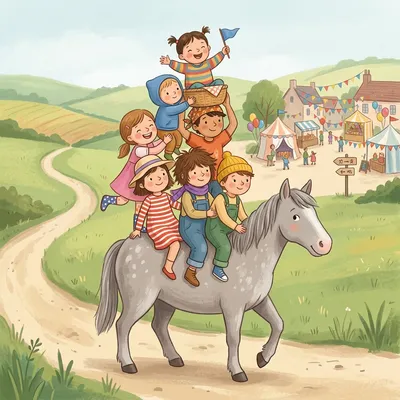
Tom Pearce, Tom Pearce, lend me your grey mare,All along, down along, out along lea.For I want for to go to Widecombe Fair,Wi' Bill Brewer, Jan Stewer, Peter Gurney,Peter Davy, Dan'l Whiddon, Harry Hawke,Old Uncle Tom Cobley and all,Old Uncle Tom Cobley and all.
And when shall I see again my grey mare?All along, down along, out along lea.By Friday soon, or Saturday noon,Wi' Bill Brewer, Jan Stewer, Peter Gurney,Peter Davy, Dan'l Whiddon, Harry Hawke,Old Uncle Tom Cobley and all,Old Uncle Tom Cobley and all.
So they harnessed and bridled the old grey mare,All along, down along, out along lea.And off they drove to Widecombe Fair,Wi' Bill Brewer, Jan Stewer, Peter Gurney,Peter Davy, Dan'l Whiddon, Harry Hawke,Old Uncle Tom Cobley and all,Old Uncle Tom Cobley and all.
History and Meaning
Most songs have a chorus. This one has a register. Seven men crowd onto a single borrowed horse and ride off to a Dartmoor fair, and their names are recited every single time the refrain comes round, ending with the line that outlived the song itself: "and Uncle Tom Cobley and all". English speakers still use that phrase to mean everyone, the whole lot, more people than the thing could reasonably hold. Which is the joke of the ballad in the first place.
Origins
The version everyone sings was published in 1890 by the Reverend Sabine Baring-Gould in Songs of the West, a collection of folk songs he gathered from singers in Devon and Cornwall. Baring-Gould was a clergyman, novelist and antiquarian who worried that the old songs were dying with the old singers, so he went out and wrote them down. The song is catalogued as Roud 137.
Widecombe-in-the-Moor is a real village, sitting in a valley below the high ground of Dartmoor with a church tower tall enough that it is visible from a long way off. Its fair is real too, held in September, and it has become a considerable draw partly because of the song. The place-name is usually pronounced "Widdicombe", which is how the ballad scans.
Like most folk songs, it did not begin with Baring-Gould. He collected a version already in circulation, and printed texts of that kind are usually the last stage of a long spoken life rather than the first. What his book did was fix one wording as the standard one and carry it out of Devon into schoolrooms and songbooks across the country.
Meaning & Interpretation
The plot is short and comic. Tom Pearce lends his grey mare to a neighbour who wants to go to the fair. The mare, it turns out, is carrying not one man but a whole crowd of them. She does not survive the outing, and the later verses have her come back as a ghostly white shape on the moor at night, rattling and sighing, which is standard fare in comic ballads of this type and is played for a shiver and a laugh rather than for horror.
The real engine of the song is the list. Every verse ends with the same seven names delivered at speed, and the pleasure is in getting through them cleanly and landing on Uncle Tom Cobley. It works as a party piece, a pub song and a children's song at once, because the tune is simple and the challenge is memorising the roll-call.
Who was Uncle Tom Cobley?
Local tradition around Dartmoor has long identified Uncle Tom Cobley as a real man from the Spreyton area, north of Widecombe, and several families have claimed the connection. The difficulty is that more than one Tom Cobley lived in that part of Devon, so the claims compete: one candidate is said to be a landowner who died in the late eighteenth century, another a relative of his of a different generation. There is no document that ties any particular Tom Cobley to the song, and the other names in the refrain are common Devon surnames, so the safest position is that the tradition is genuine and long-standing while the identification itself is unproven.
Why do people say "and Uncle Tom Cobley and all"?
Because the ballad's refrain became a shorthand for a comically long list. In British English the phrase is tacked on to the end of a group of people to mean "and everyone else as well", usually with a hint that the crowd is larger than it ought to be. It works the way "the whole nine yards" or "lock, stock and barrel" works, a fixed expression whose origin most speakers have half-forgotten while still using it correctly.
Related Nursery Rhymes

Lyrics from nurseryrhymes.info