

Come, Butter, Come


Lyrics
Come, butter, come,Come, butter, come!Peter stands at the gate,Waiting for a buttered cake;Come, butter, come!
History and Meaning
Five short lines survive from an English dairy because a man who opposed witch trials copied them into a book. In 1656 Thomas Ady published A Candle in the Dark, addressed to judges, sheriffs, justices of the peace and grand jurymen, and meant to slow them down before they sentenced anyone to death as a witch. Ady set out the everyday sayings and household habits that neighbours were reporting as proof of witchcraft, and this churning chant was one of them. He wanted readers to see an ordinary woman standing over a churn, not a criminal.
Origins
Ady was an English physician who spent most of his life in Essex and had seen witchcraft trials at first hand, including proceedings at Bury St Edmunds. His book argued from scripture that the thing being prosecuted in the courts was not the thing described in the Bible, and it picked apart the standard authorities other writers leaned on. He was working in the tradition of Reginald Scot, whose Discoverie of Witchcraft had made a similar case in 1584.
In Ady's account, an old woman explained that the charm should be repeated three times over the churn, and that her mother had learned it from a learned churchman in Queen Mary's reign, back when, as she put it, churchmen knew tricks that ministers of Ady's own day did not. Ady reports this as harmless nonsense picked up from the clergy, which was rather his point. He was needling the church as much as the accusers.
The Oxford Dictionary of Nursery Rhymes takes 1656 as the earliest record of the words. The rhyme long outlived the book. James Orchard Halliwell reprinted it in the nineteenth century among his collection of superstition rhymes, and versions turned up across England and in American farming communities, with the wording shifting from household to household. Ady's own work had one more strange afterlife: it was cited in defence at the Salem witch trials in 1692, without success.
Meaning & Interpretation
The Peter of the third line is usually read as St Peter at the gates of heaven, waiting for his share. That gives the chant the shape of a small bargain, offering a buttered cake in exchange for the butter arriving. The same pattern shows up in a lot of household sayings, where a job that seems to depend on luck gets talked to as if it can be persuaded.
The other reading is simpler and probably closer to daily life. The lines are short, heavily stressed, and repeat, which makes them useful for keeping a steady beat while your arms do something dull for a long time. Sea shanties and threshing songs work the same way. Whether a particular dairymaid believed the words did anything is impossible to know, and the two purposes sit together comfortably enough.
What is churning?
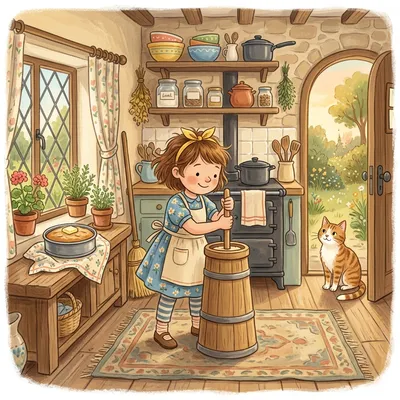
Churning is the process of agitating cream until the fat separates out into solid butter, leaving a thin liquid called buttermilk behind. In the seventeenth century this was done in a plunge churn, an upright wooden or earthenware vessel with a stick called a dasher pushed up and down through the cream. The repeated shock breaks the membranes around the fat globules so they clump together.
Why did making butter take so long?
Hand churning could run anywhere from ten minutes to two or three hours, and an hour or more was common. Temperature was the main reason for the variation, since cream will not turn properly if it is too warm or too cold, and there was no easy way to control that in a farmhouse. Households also saved several days of milk to collect enough cream to be worth the effort, so the job arrived in long sessions rather than short ones. More efficient churn designs only spread in the eighteenth century.
Was Come, Butter, Come used as a witchcraft charm?
It was spoken as a charm in the sense that people said it hoping to help the butter along, and Ady recorded it as a set of words repeated three times over the churn. But he quoted it to argue the opposite of what a modern reader might expect. His case was that sayings like this were ordinary country habit, not evidence of anything, and that courts sending people to the gallows on such material were making a serious mistake.
Who was Thomas Ady?
Thomas Ady was an English physician and writer of the mid seventeenth century, based mainly in Essex, and the author of three sceptical books about witchcraft. A Candle in the Dark is the best known. He wrote as a Christian addressing other Christians, and his method was to test popular claims about witches against the biblical text rather than against the reputations of the accused.
Related Nursery Rhymes






Lyrics from nurseryrhymes.info