
Dream Angus

Lyrics
Can ye no hush your weepin'?A' the wee lambs are sleepin'.Birdies are nestlin', nestlin' thegither,Dream Angus is hurtlin' through the heather.
Dreams to sell, fine dreams to sell,Angus is here wi' dreams to sell.Hush ye my baby and sleep without fear,Dream Angus has brought you a dream, my dear.
List' to the curlew cryin',Faintly the echoes dyin'.Even the birdies and the beasties are sleepin',But my bonnie bairnie is weepin', weepin'.
Sweet the lavrock sings at morn,Heraldin' in a bright new dawn.Wee lambs, they coorie doon thegither,Alang wi' their ewies in the heather.
History and Meaning
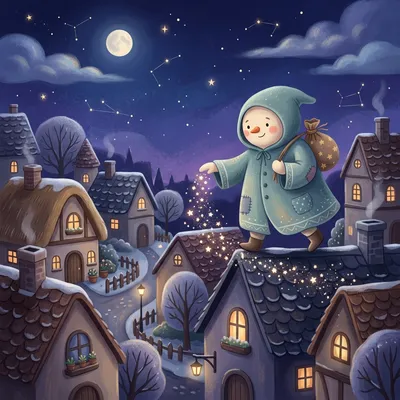
The Angus of this lullaby sells dreams. He comes over the hill with a stock of them the way a pedlar comes with ribbons and pins, and the chorus is his patter: "Dreams to sell, fine dreams to sell." His name is borrowed from Aengus, a god of Irish and Scottish Gaelic myth linked with youth and love. The dream-selling itself, the Scottish answer to the sandman, belongs to the song rather than to the old stories.
The text is Scots, not Gaelic, and it is sung to a slow air in waltz time. The child in it is still awake and still crying while the lambs, the birds and the beasties have all gone quiet, which is the oldest complaint in the lullaby trade.
Origins
The song is not ancient. The Scottish singer and collector Christina Stewart, who has gathered Scots cradle songs for years, dates the words and melody to roughly 1850 to 1890 on the evidence of their style. The oldest printed source anyone has produced is sheet music from 1923, which credits the words to George Churchill and sets them to a traditional Gaelic air.
That credit is not the only claim. A correspondent to Stewart's collection reported a family tradition that the words were written by her cousin, Mary Fraser, who lived in Edinburgh at about that period. Neither account has been settled with documents, so the honest position is that the author is unconfirmed.
The tune has a Gaelic cousin. It runs close to the lullaby "Nam bu leam fhin thu, thaladhainn thu", although the words of the two songs mean quite different things, so one melody was probably borrowed for the other rather than translated.
What carried the song across Scotland was performance. The Glasgow Orpheus Choir sang it under Sir Hugh Roberton, whose arrangements put a great deal of Scots material into schools and concert halls in the early twentieth century. Folk singers picked it up later, among them Elspeth Cowie, Jackie Oates and Claire Hastings.
Meaning & Interpretation
The verses move the child through a whole night. The first points at the sleeping lambs and nesting birds. The second is the sale. The third is dusk, with a curlew calling and the echoes fading, and the fourth has jumped to the lavrock singing at sunrise with the lambs curled up beside their ewes. Four short verses and the night is over, which is a tidy piece of construction for a song meant to be repeated until it works.
Angus offers a bargain rather than a threat, and that is worth noting, because sandman figures elsewhere are not so kind. In E.T.A. Hoffmann's 1816 story "Der Sandmann" the sand thrower is a horror who takes children's eyes. Nothing in the Scots song is menacing. Angus is out on the heather with goods to shift, and the dream is a present.
Read as interpretation rather than fact, the song also flatters the child. The dream is described as fine, brought specially, worth paying for. A parent singing it is telling a wakeful baby that sleep contains something desirable.
Who is Dream Angus?
Aengus, also written Oengus and known as Angus Og, is a god of the Tuatha De Danann in Irish and Scottish Gaelic tradition, son of the Dagda and the river goddess Boann, associated with youth, love and poetic inspiration. He is connected with the great mound of Bru na Boinne (Newgrange), which the tales say he won from his father through a trick of wording. In the medieval Irish tale "Aislinge Oenguso", "The Dream of Oengus", he falls ill with love for a woman he has only seen while asleep. She is Caer Ibormeith, who lives every second year in the shape of a swan. Aengus picks her out of a flock, turns into a swan himself, and the two fly away singing music that puts everyone who hears it to sleep for three days and nights. Note what he does in that story: he is the one who dreams. The job of walking the hills at night handing dreams to sleepless children is the lullaby's own idea, not something recorded in the old mythology.
What do the Scots words mean?
can ye no - can you not. a' - all. wee - little. thegither - together. bairnie - little child, baby. bonnie - pretty, lovely. lavrock - skylark. coorie doon - snuggle down, curl up close. ewies - ewes, mother sheep. list' - listen. A curlew, in the third verse, is a large wading bird with a long curved bill and a long rippling call heard over moorland at dusk.
Who wrote Dream Angus?
Nobody can say for certain. The 1923 sheet music names George Churchill as the writer of the words, working to an existing Gaelic melody, while a family tradition passed to collector Christina Stewart names Mary Fraser of Edinburgh. Both point to the late 1800s. The song is usually printed as traditional, which is fair enough given that it entered oral circulation quickly and no manuscript has settled the question.
Related Nursery Rhymes
Lyrics from nurseryrhymes.info