

I Had a Little Husband


Lyrics
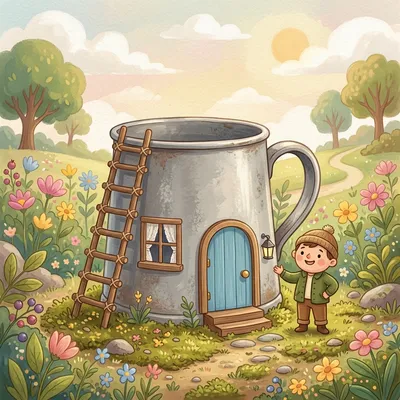
I had a little husband,No bigger than my thumb;I put him in a pint pot,And there I bid him drum.
I bought a little horseThat galloped up and down;I bridled him, and saddled him,And sent him out of town.
I gave him little gartersTo garter up his hose,And a little handkerchiefTo wipe his pretty nose.
History and Meaning
A pint pot is a drinking vessel. The husband in this rhyme fits inside one with enough room left over to drum, which tells you everything about the scale the verse is working at. Nothing in it is magical. The wife simply owns a man the size of her thumb, and she treats him the way anyone might treat a very small pet: she houses him, kits him out, buys him a horse, and sends him off.
The joke is domestic rather than fantastical. Every object named is an ordinary eighteenth-century household item, just shrunk. That miniaturising instinct runs through a lot of old English nonsense verse, and it connects this rhyme to the country's most famous small person, Tom Thumb, though not in the way people often assume.
Origins
The rhyme was printed in Gammer Gurton's Garland: or, The Nursery Parnassus, a chapbook published in 1784 by the Stockton bookseller R. Christopher. It ran to 79 rhymes, sold for twopence, and was tiny enough to pocket. Only one copy of that first edition is known to survive, held by the British Library. Later expanded editions followed, and the text is easy to consult in the 1810 edition printed for R. Triphook in London.
The collection was assembled by Joseph Ritson (1752 to 1803), an antiquary from Stockton-on-Tees who spent his career in London chasing down old ballads, songs and popular texts. Ritson had bought a copy of the pioneering collection Mother Goose's Melody in 1781, and soon afterwards asked his nephew to write down any nursery rhymes he came across. Gammer Gurton's Garland was the result, and it put a number of now familiar rhymes into print for the first time. That makes it one of the genuine landmarks of English nursery rhyme collecting, alongside the much later work of James Orchard Halliwell in the nineteenth century.
Because Ritson was a collector rather than an author, the verse is certainly older than 1784 in speech. How much older is unknown. There is no earlier printing anyone has produced, so 1784 is the honest date to give.
Meaning & Interpretation
The comedy runs on inversion. In the century that produced the rhyme, a husband was the legal head of a household and a wife's property was largely his. This wife does the buying, the bridling, the saddling and the sending. Her husband is an object she manages, small enough to be stored in the crockery. Whether any singer ever thought that hard about it is doubtful, but the reversal is what makes the first line land.
The details are period-accurate rather than invented. Men wore stockings, called hose, held up with garters, so outfitting a miniature man in garters and a handkerchief is exactly the sort of specificity that makes a small-scale joke work. The drumming in the pot suggests noise as well as size, a husband reduced to a rattling nuisance in a tankard.
Is the husband in this rhyme Tom Thumb?
No, and the rhyme never names him. Tom Thumb is a separate figure from English folklore, a thumb-sized hero attached to the court of King Arthur, whose printed story goes back to The History of Tom Thumbe, the Little, published in London in 1621 and generally regarded as the first fairy tale printed in English. Its author is presumed to be Richard Johnson, whose initials appear at the end. The rhyme borrows the thumb-sized idea that Tom made popular, but its little man has no adventures, no name and no rescue to perform.
How old is the Tom Thumb story?
Older than its first surviving printing. Tom is mentioned in sixteenth-century writing, including Reginald Scot's The Discoverie of Witchcraft of 1584, where he appears among the figures servants used to frighten children. The 1621 booklet, the only known copy of which is in the Pierpont Morgan Library in New York, was therefore setting down a story already circulating in speech.
What is a pint pot?
A pint pot is a drinking vessel holding one pint, usually pewter or earthenware in the period the rhyme comes from. It would have been in every kitchen and every alehouse, which is the point: the wife does not build a special house for her husband, she puts him in the nearest cup.
What are hose and garters?
Hose are stockings, and garters are the bands that held them up before elastic existed. Both were everyday menswear in the eighteenth century, so the lines describe the wife buying her husband perfectly normal clothing in an absurdly small size.
Related Nursery Rhymes




Lyrics from nurseryrhymes.info