
Little Jenny Wren

Lyrics
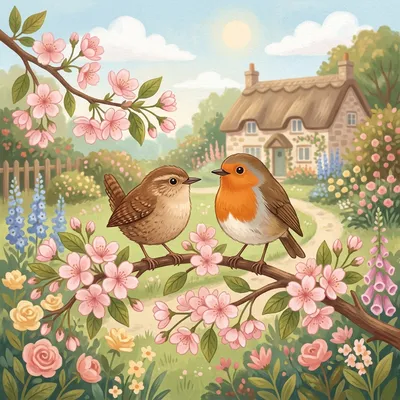
Little Jenny Wren fell sick,Upon a merry time;In came Robin RedbreastAnd brought her sops and wine.
Eat well of the sop, Jenny,Drink well of the wine;Thank you, Robin, kindly,You shall be mine.
Then Jenny she got well,And stood upon her feet,And told Robin plainlyShe loved him not a bit.
Robin, he was angry,And hopped upon a twig,Saying, Out upon you, fie upon you,Bold-faced jig!
History and Meaning
Four short verses, one small betrayal. Jenny Wren takes to her sickbed, Robin Redbreast arrives with food and wine, she promises herself to him while she is still weak, and the moment she can stand she tells him she never loved him at all. Robin hops off in a temper and calls her a name. It is one of the few nursery rhymes with a genuine plot twist, and it only works because British folk tradition had already decided that the robin and the wren belonged together.
Origins
What can be said with confidence is limited. "Little Jenny Wren" is an English nursery rhyme that circulated in print in the standard children's collections and has been reprinted in more or less this form ever since. Beyond that, the trail is thin. No first printing can be pinned down with certainty here, no author is known, and dates that get repeated online for this particular rhyme are not something we can verify, so this page does not give one.
What is better documented is the wider family the rhyme sits in. Robin Redbreast and Jenny Wren appear together across a whole cluster of English rhymes and chapbook verses about courtship, marriage, sickness and death, of which Who Killed Cock Robin is the most famous. Others in the group have Robin and Jenny actually marrying, with a wedding feast and a cast of birds. "Little Jenny Wren" reads like the sour version of that story, the courtship that falls through. Whether it came first, last, or somewhere in the middle of that cluster is not something the surviving printed record settles.
Meaning & Interpretation
The joke depends on knowing that the two birds were a couple in folk belief before they were characters in a rhyme. Across England the robin and the wren were paired in sayings, sometimes as husband and wife, sometimes as "God Almighty's cock and hen", as though the little brown wren were simply the female of the red-breasted robin. That is folk belief rather than ornithology. They are not the same species and not a breeding pair.
The pairing came with a taboo. Rhyming warnings against disturbing either bird or its nest were collected all over the country. A Devon version ran "Kill a robin or a wren, never prosper, boy or man". An Essex one warned that anyone taking the birds from the nest would never thrive again. Elsewhere the couplet promised that whoever harried their nest would never have rest for his soul. Children learned these as flat statements of consequence, and the birds were left alone.
Set against that background, the rhyme is gently subversive. Robin does everything right, feeding Jenny sops, which is bread soaked in wine or broth, the standard invalid food of the period, and he is thrown over anyway. His parting shot, "bold-faced jig", is old abuse aimed at a woman thought forward or brazen. Some printed versions soften the ending or stop earlier, and in a few Jenny simply recovers and flies away rather than delivering the refusal outright. The variation suggests the rhyme was reshaped repeatedly by whoever was singing it.
The wren carried a second, harsher tradition alongside the protective one. On St Stephen's Day, 26 December, groups known as wren boys in Ireland and parts of Britain paraded a wren on a decorated pole from house to house, singing and collecting money. The bird is no longer hunted in the modern revival, and a fake or stuffed wren is used, but the custom is still kept in parts of Kerry and elsewhere.
Why are the robin and the wren always paired?
Because English folk belief treated them as a couple, often as husband and wife or as "God Almighty's cock and hen", with the wren spoken of as if she were the female robin. Both birds were protected by rhyming taboos warning that anyone who harmed them or robbed their nests would suffer for it. That belief is well recorded in British folklore collections. It is not biology, since the two are unrelated species, but it explains why so many rhymes cast Robin and Jenny opposite each other.
What are sops and wine?
Sops were pieces of bread soaked in wine or broth, a soft food given to the sick and the elderly for centuries before nursery rhymes were written down. Robin bringing Jenny "sops and wine" is the ordinary sickroom care of the day, which is what makes her refusal afterwards feel so pointed.
Is Little Jenny Wren connected to Who Killed Cock Robin?
They belong to the same family of English bird rhymes, in which Robin Redbreast and Jenny Wren appear as recurring characters through courtship, marriage and death. In Who Killed Cock Robin the whole community of birds mourns Robin's killing. Whether either rhyme was written with the other in mind cannot be established, but audiences plainly knew the same two birds in both.
What does "bold-faced jig" mean?
It is an old insult meaning a brazen or shameless woman, "bold-faced" carrying its usual sense of impudent and "jig" used here as a term of abuse rather than the dance. Robin throws it at Jenny from a safe distance on a twig, which is the closest the rhyme comes to a punchline.
Related Nursery Rhymes


Lyrics from nurseryrhymes.info