

Make New Friends
Lyrics
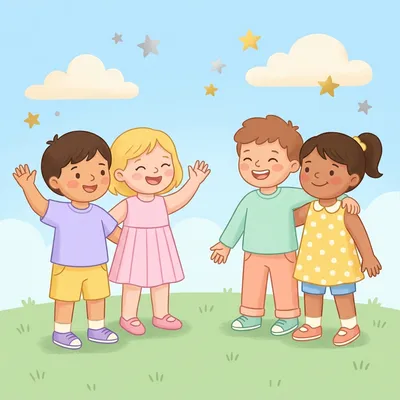
Make new friends,But keep the old.One is silver,And the other is gold.
History and Meaning
Two lines, four short phrases, and a proverb about metals. "Make New Friends" is one of the shortest songs a child is likely to learn by heart, and one of the most repeated at Girl Scout and Girlguiding gatherings, where it gets sung in a circle at the end of a meeting or around a campfire at the close of a camp. Nobody knows for certain who wrote it. That is worth saying plainly, because the internet is full of confident credits that do not survive a look at the evidence.
Origins
The couplet exists in two layers. The saying itself, comparing new friends to silver and old friends to gold, circulated as a proverb well before anyone set it to music, and versions of that idea appear in nineteenth century autograph books and copybook collections. Turning it into a singable round is the newer part, and the moment of that turn is not documented.
The name attached most often is Joseph Parry, a Welsh composer who died in 1903. That attribution is unproven. It appears in songbooks and on websites without a source, and no early printing of the round has been produced that carries his name. Some accounts instead credit an unnamed Girl Scout leader, or place the song's spread in the American Girl Scout movement of the 1920s and 1930s. Those are plausible routes for how it travelled, but they are not proof of who composed it.
What is documented is the song's role. By the mid twentieth century it was firmly fixed in Girl Scout and Guiding songbooks on both sides of the Atlantic, usually printed as a round and usually placed in the closing or friendship section alongside the friendship circle and the squeeze passed hand to hand. Scouting, camp programmes, and school music classes picked it up from there. Some songbooks add later verses about circles being round and having no end, but those are additions to the original two lines rather than part of them.
Meaning & Interpretation
The metaphor is simple and slightly counterintuitive, which is probably why it sticks. Silver is valuable, so a new friend is a genuinely good thing. But gold is worth more, so the old friend outranks the new one. The song is not telling children to stop meeting people. It is telling them that the friendships they already have took time to build and should not be dropped for whatever is newest.
That message suits the setting it grew up in. Guiding and Scouting groups mix children who have known each other for years with newcomers who joined last week, and camps throw strangers together for a few days. Singing this at the end of a session gives the group a way of naming both relationships at once.
How do you sing Make New Friends as a round?
Sing it in two, three, or four parts, with each new group entering after the group ahead of it has finished one line. Group one starts with "Make new friends"; when they move on to "But keep the old", group two begins at "Make new friends". Group three enters as group two reaches the second line, and group four follows the same way. Everyone sings the whole song through two or three times, then either stops together at an agreed point or drops out group by group in the order they entered, which lets the last group finish alone. Four parts is the maximum that works cleanly, since the song has four phrases. Two parts is easier with younger children and still gives the overlapping effect. It helps to have a confident singer or leader anchoring each part, because the harmony only holds if nobody drifts across to the louder group.
Why do Girl Scouts sing Make New Friends?
It is the traditional closing song for Girl Scout and Girlguiding meetings and campfires, sung in a friendship circle where everyone crosses arms, joins hands, and often passes a hand squeeze around the ring while the round is going. The words fit the moment: the group has spent time together, some members are long-standing and some are brand new, and the silver and gold line acknowledges both. Its shortness matters too. Nobody needs a songbook, and a five year old can join the second time around.
Related Nursery Rhymes




Lyrics from nurseryrhymes.info