
Oats, Peas, Beans and Barley Grow
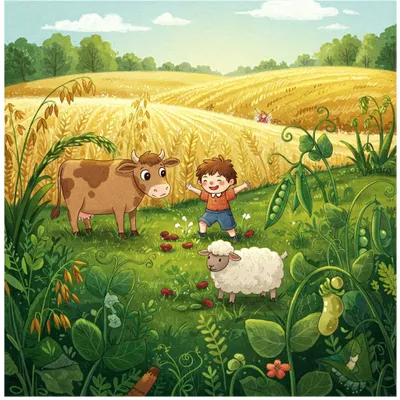

Lyrics
(This is often sung as a circle game, with actions matching the words)
Oats, peas, beans, and barley grow,Oats, peas, beans, and barley grow,Nor you nor I nor anyone knowsHow oats, peas, beans, and barley grow.
Thus the farmer sows his seed,Thus he stands and takes his ease,Stamps his foot and claps his hands,And turns around to view his lands.
Waiting for a partner,Waiting for a partner,Open the ring and take one in,Make haste and choose your partner.
(Game instructions often follow, e.g., "Now you're married, you must obey...")
History and Meaning
The chorus asks a question nobody can really answer: how do oats, peas, beans, and barley actually grow? Around that small mystery the song builds a circle game in which a "farmer" mimes sowing, resting, stamping, and surveying his fields. It spread from Britain across North America. Its melody, called "Baltimore," appears in Joshua Cushing's 1790 The Fifer's Companion, while the earliest printed lyrics show up in Alice Bertha Gomme's 1898 The Traditional Games of England, Scotland and Ireland.
How do you play the Oats, Peas, Beans and Barley Grow game?
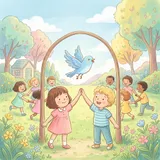
This song functions primarily as a "play song" or singing game. Traditionally, children perform it while standing in a ring, incorporating actions that correspond to the lyrics. These movements mimic the farmer's activities described in the verses: sowing seed, standing at ease, stamping feet, clapping hands, and turning around to survey the land. Often, one child takes on the role of the farmer within the center of the circle. The song found a special place in schoolhouses and rural areas as a "play party" song, providing communities where dancing was often religiously frowned upon with a socially acceptable alternative for communal musical activity, social interaction, and courtship rituals.
Agricultural Themes and Education
The lyrics clearly detail the agricultural cycle, creating an explicit connection to farming and seasonal rhythms. Phrases like "First, the farmer sows his seed," "Next, the farmer waters the seed," and "Last, the farmer harvests the peas" provide a simple narrative of crop cultivation. This agricultural focus has made the song a natural educational tool, teaching children about farming practices, gardening, plant growth, and seasonal changes. The chorus itself, "Do you or I or anyone know / How oats, peas, beans and barley grow?", expresses a sense of wonder at natural growth processes while describing the farmer's vital role in cultivation.
Are there hidden meanings behind the song?
Some interpretations link "Oats, Peas, Beans and Barley Grow" to ancient pagan fertility rites, suggesting that the farmer's actions in the game (stamping feet, clapping hands, turning around) might be vestiges of rituals intended to drive evil spirits from the soil. Lyrical references to partnership or marriage have been speculatively connected to ritual marriages similar to those in traditional Mummers plays. However, these interpretations remain speculative, as the song can be understood more straightforwardly as a simple guide to farming or a playful children's game with agricultural themes. The clear connection to agricultural practices and children's games suggests caution when attributing ancient ritualistic meanings without strong historical evidence.
Music Video
If the player is unavailable, watch this video on YouTube.
Related Nursery Rhymes
Lyrics from nurseryrhymes.info