

Round the Rugged Rock

Lyrics
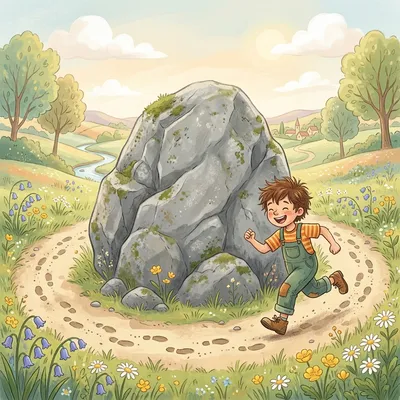
Round the rugged rock the ragged rascal ran.
Round and round the rugged rockThe ragged rascal ran.
History and Meaning
Eight words, six of them beginning with R. "Round the rugged rock the ragged rascal ran" is the standard English drill for that letter, the R equivalent of "Peter Piper" for P and "she sells seashells" for S. Nobody has identified who wrote it.
What makes it worth reciting is the way it fails. Said slowly it is easy. Said at speed, "rugged" and "ragged" swap their vowels and the rascal comes out rugged while the rock comes out ragged, which is the joke every child discovers within three attempts.
Origins
The earliest printing has not been pinned down, and no named author can be credited. What is documented is the tradition the line belongs to. Elocution was a formal school subject in nineteenth century Britain, with its own textbooks, examinations and prize recitations, and those manuals routinely carried sections headed "exercises in articulation": short sentences loaded with a single consonant, repeated until the speaker could produce them cleanly and quickly. The best documented survivor of that genre is Peter Piper's Practical Principles of Plain and Perfect Pronunciation, published in London in 1813, which supplied an alliterative sentence for every letter of the alphabet for exactly this purpose.
"Round the rugged rock" fits the pattern precisely, and in Britain it is remembered as an elocution line rather than as a nursery story. The honest description of its age is nineteenth century elocution practice in general, not a specific book or date.
Several versions circulate. The short form above is the common one. A longer variant adds two more R words: "Round the rough and rugged rock the ragged rascal rudely ran." There is also a playground riddle version in which the reciter finishes the line and then demands to know how many R's there are in "that", the answer being none.
Meaning & Interpretation
There is no story here, and that is deliberate. A rascal, ragged in the sense of shabbily dressed, runs around a rock. The sentence exists to be difficult rather than to mean anything, so its words were picked for their sounds. "Rascal" was a mild Victorian word for a rogue or a scruffy troublemaker, soft enough to use about a child. "Rugged" simply means rough and broken.
The near-identical shapes of "rugged" and "ragged" are not an accident of vocabulary. They are the exercise. Remove that pair and the line becomes ordinary.
Why is Round the Rugged Rock so hard to say?
Two separate difficulties stack on top of each other. The first is the English R sound itself, a postalveolar approximant, which means the tongue rises close to the ridge behind the upper teeth without ever touching it. Speakers make it either by curling the tongue tip back or by bunching the body of the tongue upward, and both shapes come with rounded lips, so each R demands a full reset of the mouth rather than a quick tap.
The second difficulty is what sits between the R sounds. "Rugged", "rock", "ragged" and "rascal" all contain a velar stop, produced by pressing the back of the tongue against the soft palate. Each "the" needs a dental fricative, tongue tip at the upper teeth. So the tongue cycles from the postalveolar approximant to the back of the mouth and forward again to the teeth, six times over in eight words, at conversational speed.
Then comes the trap. "Rugged" and "ragged" share an identical consonant frame and differ only in the stressed vowel, which is the arrangement most likely to cause a swap. Speech planning holds several upcoming words in memory at once, and near-twin neighbours invite the wrong vowel to surface early. The result is the familiar wreck: "the rugged rascal ran round the ragged rock."
One more feature worth noting: every R in the line starts a syllable. That means it is pronounced in every accent, rhotic or not, so the drill works the same for a speaker in Boston, Bristol or Brisbane.
Did Victorian schools really teach tongue twisters?
Yes. Clear public speaking was taught explicitly in nineteenth century British and American classrooms, and articulation drills were a standard part of it. Elocution manuals grouped short alliterative sentences by consonant and set them as repetition exercises, on the reasoning that the muscles of speech improve with targeted practice in the same way any other muscles do. Alliterative puzzles of this kind also circulated as parlour entertainment among adults, so the same sentence could be a lesson on Monday and a party game on Saturday.
Is Round the Rugged Rock good speech practice for children?
It is genuinely useful, with a caveat about pace. R is one of the later English consonants for children to master, alongside L, S and "th", and it is a common reason families are referred to a speech and language therapist. A short line built entirely from R onsets gives concentrated practice without asking a child to hold much in memory.
The way to use it is slowly first. Have the child say each word separately with an exaggerated R, then join two words, then three, and only build up speed once the sounds are clean. Racing straight to top speed practises the error rather than the sound. If a child's R sounds consistently come out as W, that is worth mentioning to a professional rather than drilling away at home.
What does "ragged rascal" mean?
A rascal is a mischievous or dishonest person, used lightly and often affectionately, and ragged means dressed in torn or worn out clothes. Together they describe a scruffy young troublemaker, the kind of character a Victorian reader would picture running loose outdoors. The phrase carries no particular story or moral; it was chosen because both words begin with R and pack a hard G behind it.
Related Nursery Rhymes




Lyrics from nurseryrhymes.info