
The Derby Ram

Lyrics
As I was going to Derby,All on a market day,I met the finest ram, sir,That ever was fed on hay.
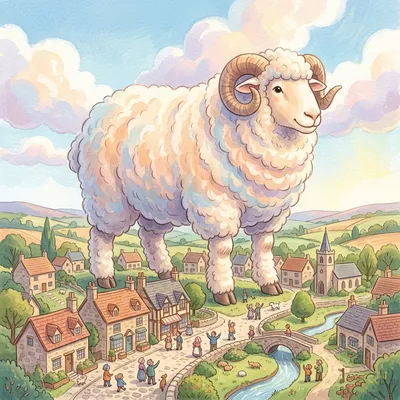
This ram was fat behind, sir,This ram was fat before,This ram was ten yards high, sir,Indeed he was no more.
The wool upon his back, sir,It reached up to the sky,The eagles built their nests there,For I heard the young ones cry.
The wool upon his belly, sir,It dragged upon the ground,It was sold in Derby town, sir,For forty thousand pound.
The horns upon his head, sir,They reached up to the moon,A man went up in JanuaryAnd didn't come down till June.
The space between his horns, sir,Was as far as a man could reach,And there they built a pulpitFor the parson there to preach.
The tail upon his back, sir,Was fifty yards and an ell,And it was sent to DerbyTo ring the market bell.
And if you think I'm lying, sir,And think I tell a lie,Then go you down to DerbyAnd see the same as I.
History and Meaning
A ram ten yards high, with wool that reaches the sky and horns a man needs five months to climb. "The Derby Ram" is a boasting song, and the joke is that the singer keeps insisting on his own accuracy while the numbers get sillier. "Indeed he was no more" is the line that gives it away: the narrator is being modest about a sheep the size of a church.
Every verse follows the same recipe. Name a part of the animal, then measure it against something impossible. Eagles nest in the fleece. A parson preaches from a pulpit built between the horns. The tail becomes the rope for Derby's market bell. Children join in because the pattern is obvious after two verses, and because the last line dares you to go and check.
Origins
The song is catalogued as Roud 126 and belongs to Derbyshire in the English Midlands. It was already a byword for a long, exaggerated story by 1739, when the vicar of St Alkmund's Church in Derby ended a letter to his son by comparing it to "that of the Derby Ram". That reference tells us the song was familiar before anyone bothered to print it.
The earliest known printing is around 1790, in a chapbook called A Garland of New Songs issued by Angus of Newcastle, under the title "The Old Ram of Derby". Only a handful of nineteenth century broadside versions survive, from Such and Disley in London and Angus in Newcastle, which is unusual for a song this widely sung. It travelled with emigrants to North America, where it turns up as "The Darby Ram", and it shades into related songs including "The Yorkshire Tup".
In Derbyshire and south Yorkshire the ram also appears in a midwinter house-visiting custom called the Old Tup, in which performers carried a wooden sheep's head and acted out a version of the song. Fuller traditional texts continue past the verses above into the butchering of the ram and the fantastical uses found for its parts, which is where those custom performances take their action from.
Most versions carry a nonsense chorus between verses, along the lines of "Daddle-i-day, daddle-i-day", which gives everyone something to shout while the next boast is prepared.
Meaning & Interpretation
There is no hidden message. The Derby Ram is a lying song, a form found across English folk tradition where the pleasure comes from competitive exaggeration delivered deadpan. Some folk enthusiasts have claimed the ram descends from pagan fertility ritual, but there is no evidence for it, and the song reads far more naturally as tavern and market-day entertainment.
What the song did do is give Derby an emblem. The First Regiment of Derbyshire Militia adopted it as a regimental song in 1855, and the ram became fixed to the town's identity from there. In 1858 the 95th (Derbyshire) Regiment of Foot found a fighting ram in India and kept him as a mascot; the tradition survives today in the Mercian Regiment, whose live Swaledale ram mascot is called Private Derby and leads the regiment on parade. Since 1912 replacement rams have been presented from the Duke of Devonshire's flock at Chatsworth. Derby County Football Club, founded in 1884, are nicknamed the Rams for the same reason and carry a ram's head on the badge.
Why is the ram in the song so big?
Because the song is a deliberate tall tale. Each verse picks one feature and stretches it past belief, and the humour comes from the singer reporting these measurements as sober fact. Songs built this way were a common form of English comic entertainment, and the closing verse, which invites doubters to travel to Derby and see for themselves, is the punchline.
Is the Derby Ram a real animal?
No. The ram of the song never existed. The animal that people point to in Derby today is a symbol rather than a specific sheep: a ram appears in the city's civic imagery, on Derby County's crest, and as the regimental mascot Private Derby, a real Swaledale ram named after the song rather than the other way around.
How old is The Derby Ram?
It is at least an eighteenth century song. A 1739 letter by the vicar of St Alkmund's in Derby already uses it as shorthand for a tall story, so it was well known by then, and the first surviving printing dates from about 1790. Its exact age is unknown, as with most songs carried by singing long before anyone wrote them down.
Related Nursery Rhymes




Lyrics from nurseryrhymes.info