
The Duel


Lyrics
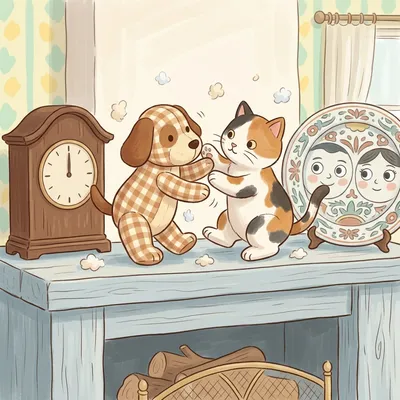
The gingham dog and the calico catSide by side on the table sat;'Twas half-past twelve, and (what do you think!)Nor one nor t'other had slept a wink!The old Dutch clock and the Chinese plateAppeared to know as sure as fateThere was going to be a terrible spat.(I wasn't there; I simply stateWhat was told to me by the Chinese plate!)
The gingham dog went "Bow-wow-wow!"And the calico cat replied "Mee-ow!"The air was littered, an hour or so,With bits of gingham and calico,While the old Dutch clock in the chimney placeUp with its hands before its face,For it always dreaded a family row!(Now mind: I'm only telling youWhat the old Dutch clock declares is true!)
The Chinese plate looked very blue,And wailed, "Oh, dear! what shall we do!"But the gingham dog and the calico catWallowed this way and tumbled that,Employing every tooth and clawIn the awfullest way you ever saw,And, oh! how the gingham and calico flew!(Don't fancy I exaggerate,I got my news from the Chinese plate!)
Next morning where the two had satThey found no trace of dog or cat;And some folks think unto this dayThat burglars stole that pair away!But the truth about the cat and pupIs this: they ate each other up!Now what do you really think of that!(The old Dutch clock it told me so,And that is how I came to know.)
History and Meaning
Two stuffed toys sit on a table at half-past twelve, pick a fight, and by breakfast there is nothing left of either one. That is the whole plot of Eugene Field's "The Duel", printed in his collection Love-Songs of Childhood in 1894. The fight is not the interesting part. Who is telling you about it is.
The witnesses are an old Dutch clock and a Chinese plate. The clock throws its hands over its face because it hates a row. The plate turns blue and wails. And the narrator keeps stopping his own poem to admit he was not in the room, first with "I wasn't there; I simply state / What was told to me by the Chinese plate!" and then three more times before the end. Every fact in the poem is secondhand. The reader is being asked to trust the testimony of crockery.
Origins
Eugene Field lived from 1850 to 1895. He was born in St. Louis, Missouri, and spent his career in newspapers rather than in literature. From 1883 he wrote "Sharps and Flats", a daily humor column for the Chicago Daily News that was reprinted in papers across the country. The verse he wrote for children ran alongside the jokes and the political needling, and it made him famous enough to be called the children's poet, a nickname he is said to have disliked.
"The Duel" appeared in Love-Songs of Childhood in 1894, the year before Field died. It is often listed under its first line as "The Gingham Dog and the Calico Cat", which is how most people know it.
Some sources date the poem to 1888. That does not match the book. Field did publish "Little Boy Blue" in 1888, and that may account for the slip.
The toys themselves were an ordinary product of the period. Cut-and-sew cloth animals, printed flat on fabric so a family could cut them out and stuff them at home, went on sale in the United States in the early 1890s, with Arnold Print Works among the firms selling them by the yard. A dog made of checked gingham and a cat made of printed calico would have been a plausible pair to find sitting on a nursery table when Field wrote.
Meaning & Interpretation
The framing device carries the poem. Field sets up a story about violence between two characters who cannot possibly commit it, then refuses to vouch for any of it. All four stanzas end with a parenthetical hedge crediting the clock or the plate. The joke lands in the last two lines, where the narrator finally reveals that his source for the most dramatic fact in the poem, the one about what became of the dog and the cat, was a clock.
The poem also floats a rival explanation and drops it. Some folks think burglars took the pair. The narrator dismisses that in favour of the clock's version, which is the less believable of the two and stated with far more confidence.
Adults often read the poem as a comment on quarrels that finish off both sides. Field does not spell that out, and the verse works perfectly well without it. The tone is closer to a tall tale told with a straight face. Read aloud, the pleasure is in the sound: "bow-wow-wow" against "mee-ow", the air littered with scraps of cloth, and the run of short knocking rhymes on cat, sat, spat, plate, fate, state.
What do "gingham" and "calico" mean?
Both are patterned cotton fabrics, which is why the toys are named after them. Gingham is woven from pre-dyed yarn into checks or stripes, so the pattern runs all the way through the cloth. Calico, in American usage, is plain cotton with a pattern printed on the surface, usually small flowers or figures on a pale background. In Britain calico usually means plain unprinted cotton instead. American readers also use calico for a cat with patched orange, black and white fur, which makes the phrase "calico cat" sound doubly right.
Who wrote The Duel?
Eugene Field, an American newspaper writer and poet who lived from 1850 to 1895. He wrote the "Sharps and Flats" column for the Chicago Daily News from 1883 and published several collections of verse for children. His best known poem is Wynken, Blynken, and Nod, a lullaby about three fishermen who sail off in a wooden shoe. "The Duel" comes from Love-Songs of Childhood, 1894.
What happens to the gingham dog and the calico cat?
They eat each other up. The poem states it plainly in the final stanza, after noting that the table was empty next morning and that some people blamed burglars. Because the pair are stuffed cloth toys, the scene is nearer to two cushions bursting than to anything upsetting, and Field plays it for comedy throughout, with the air "littered" with bits of gingham and calico and the clock hiding its face.
Is the story in the poem meant to be true?
No, and the poem says so itself. The narrator admits in every stanza that he was not present and is repeating what the Chinese plate and the old Dutch clock told him. That running confession is the point of the piece rather than a detail in it. Field ends on the least reliable source of all, which leaves the reader holding a dramatic account of an event that nobody with a mouth ever witnessed.
Related Nursery Rhymes

Lyrics from nurseryrhymes.info