
The Man in the Wilderness

Lyrics
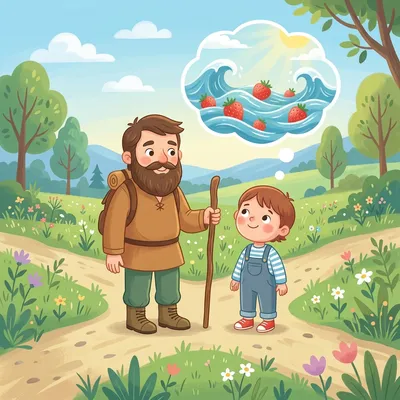
The man in the wilderness asked meHow many strawberries grow in the sea.I answered him as I thought good,As many red herrings as swim in the wood.
The man in the wilderness asked me whyHis hen could swim and his pig could fly.I answered him as I thought best,They were both born in a cuckoo's nest.
History and Meaning
A stranger stops a child and asks how many strawberries grow in the sea. The child does not say "none" and does not say "strawberries do not grow in the sea". The child says: as many as the red herrings that swim in the wood. That reply is the whole rhyme. It refuses the question by playing the question's own game, and it wins.
Most nonsense verse for children works by describing silly things. This one works by staging an argument, and the child in the rhyme is the one holding the better cards. Four lines, one exchange, and the listener is on the child's side.
Origins
The rhyme is English and appears in printed nursery collections from the early nineteenth century onward. It shows up in "Gammer Gurton's Garland", where it carries the plain title "Strawberries", and crossed to America in the Boston "Mother Goose" chapbooks of the 1830s. From there it settled into the standard canon: Andrew Lang printed it in "The Nursery Rhyme Book" in 1897, and Jessie Willcox Smith illustrated it in "The Little Mother Goose" in 1912. It has been continuously in print in children's books for more than two hundred years.
How much older it is orally, nobody can say. Riddling question-and-answer verses of this kind circulated long before collectors began writing them down, and a rhyme this compact is exactly the sort that survives by being repeated rather than recorded. Claims of a specific seventeenth-century source turn up in places, but no such printing has been traced.
The text is unstable, which is normal for a rhyme kept alive by memory. Some versions say "grew in the sea" rather than "grow", and "as many red herrings as grew in the wood" rather than "swim". Some carry only the first stanza. Others add the hen-and-pig exchange, a third verse in which the man asks the child to count the sands of the sea, or a question about how many ships sail in the forest. The forest-and-ships image also floats around in traditional song, so it is hard to say which borrowed from which.
Meaning & Interpretation
There is no hidden history here, no plague or king or tax revolt. The rhyme is about how to handle a bad question.
The man asks something with no possible answer. The child could correct him, which would be dull, or refuse, which would be rude. Instead the child answers in the same currency: an impossible question earns an impossible number. The two absurdities cancel out, and the exchange stays polite on the surface while being entirely devastating underneath. Children get this immediately, long before they could explain it, because they already play this way with each other.
The second stanza does the same trick again with the hen that swims and the pig that flies. "Born in a cuckoo's nest" is a joke answer that sounds like a real explanation, which is why it lands. Cuckoos famously lay their eggs in other birds' nests, so the line hands the man a piece of genuine natural history bent into nonsense.
The "man in the wilderness" himself is never explained. He has no name, no reason for being out there, and no reaction to the answer he gets. That blankness is useful. It leaves the listener with nothing to do but enjoy the reply.
What is a red herring?
A red herring is a real food: a herring cured hard in salt brine and then smoked, sometimes for days, until the flesh turns a coppery red and the smell is very strong. That is the meaning a child hearing this rhyme two hundred years ago would have had in mind, an ordinary preserved fish from a barrel. The modern figurative sense, a misleading clue that pulls you off the trail, spread later; the English writer William Cobbett popularised it around 1805 with a story about using a cured herring to throw hunting hounds off a scent.
Are there other verses to The Man in the Wilderness?
Yes. The strawberries-and-herrings quatrain is the fixed core, but printed versions add anywhere from one to three more exchanges. The common extras are the hen that swims and the pig that flies, a request to count the sands of the sea, and in some tellings a question about how many ships sail in the forest. Different collections print different combinations, and none of them is the official one.
Why do children find this rhyme funny?
Because the child in the rhyme beats an adult at his own game without breaking any rules. The question is nonsense, so the answer is nonsense, and matching the man exactly is a sharper move than correcting him would be. Young listeners recognise the structure from their own playground arguments, which is why the joke works before anyone has to explain it.
Related Nursery Rhymes




Lyrics from nurseryrhymes.info