
The Old Gray Mare

Lyrics
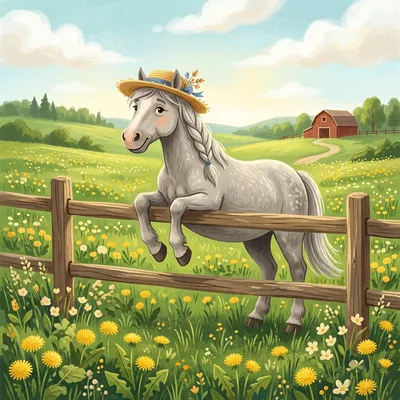
The old gray mare, she ain't what she used to be,Ain't what she used to be, ain't what she used to be.The old gray mare, she ain't what she used to be,Many long years ago.
Many long years ago, many long years ago,The old gray mare, she ain't what she used to be,Many long years ago.
The old gray mare, she kicked on the whiffletree,Kicked on the whiffletree, kicked on the whiffletree.The old gray mare, she kicked on the whiffletree,Many long years ago.
History and Meaning
Most nursery songs stay in the nursery. This one got out. "The old gray mare, she ain't what she used to be" is now a stock phrase in American English, used by people who have no idea it came from a children's song and could not sing a bar of the tune. You will hear it about a car with 200,000 miles on it, a knee after a long hike, a football team in a rebuilding year, and most often about the speaker's own body.
The song itself is barely a song. Three lines repeat, a fourth closes the verse, and the whole thing turns over again. That repetition is exactly why small children can sing it after hearing it twice, and why it survived long enough for the refrain to break loose.
Origins
The dating is unusually messy, which is why no single year is listed for this page. The melody is much older than the words most people know. It appeared in print in 1858 as "Down in Alabam'", credited to J. Warner of Bryant's Minstrels and published in New York by Wm. Hall & Son. That tune had a busy life on its own. It was fitted with new words as "Old Abe Lincoln Came Out of the Wilderness" during the 1860 campaign, a common practice when a melody was already in everyone's ear.
The version we sing now, with the gray mare and the refrain about what she used to be, is a twentieth century arrival. The first known publication of it dates to around 1915, in an arrangement by Frank Panella, and a Pathe recording by the University Quartet followed in 1917. So the tune is Civil War era and the famous words are World War I era, roughly sixty years apart.
A separate story, repeated often but never documented, links the song to Lady Suffolk, a real gray trotting mare who in 1843 became the first horse recorded trotting a mile in under two and a half minutes. It is a good story and it may even be true, but it is reported tradition rather than established fact, and it should be treated that way.
Meaning & Interpretation
The literal picture is a working farm horse past her prime. A mare who once pulled hard now kicks at the whiffletree, the pivoting bar that connects a horse's harness to whatever it is dragging. She is balky, slower, less use than she was. "Many long years ago" is the song's quiet punchline: the good years are not just gone, they are far gone.
What makes the phrase stick is the tone. It is not bitter and it is not sad. It shrugs. That is why it works so well said about oneself, usually while getting up out of a chair, and why it has outlived every other line in the song. The mare has become entirely optional to the meaning.
Is this the same song as "John Cook Had a Little Grey Mare"?
No. They are two different songs that people mix up constantly because both have a grey mare in the title. John Cook Had a Little Grey Mare is an older English rhyme with a nonsense refrain about the mare's leg, hip and knee, and a story about John Cook riding to market. "The Old Gray Mare" is American, has no John Cook in it, and uses a completely different tune. Different country, different century, different song.
What does "the old gray mare ain't what she used to be" mean?
It means something or someone has declined with age and no longer performs the way it once did. The phrase is almost always affectionate or self-deprecating rather than cruel, which is how it survived into everyday speech. People apply it to their own knees and backs, to aging vehicles and appliances, and to institutions or teams that were once dominant.
What is a whiffletree?
A whiffletree, also spelled whippletree, is the pivoting wooden crossbar that links a horse's harness traces to a plough, wagon or cart. It swings as the horse walks so the pull stays even. When the song says the mare "kicked on the whiffletree", it means she kicked backwards against her own gear, the behaviour of an animal who has had enough of the job.
Related Nursery Rhymes



Lyrics from nurseryrhymes.info