
The Two Cats of Kilkenny

Lyrics
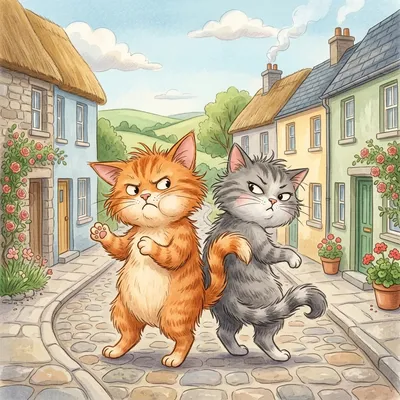
There were once two cats of Kilkenny,Each thought there was one cat too many;So they fought and they fit,And they scratched and they bit,Till, excepting their nailsAnd the tips of their tails,Instead of two cats, there weren't any.
History and Meaning
The verse most people know first appeared in an American magazine. In November 1867 The Galaxy, a New York monthly, printed a dialect version of the Kilkenny cats rhyme alongside a mock-solemn essay that called it "the Kilkenny epic" and compared its unknown author to Homer. The joke underneath it is older. A miscellany of humorous scraps called Anthologia carried the story in June 1807, told as an Irish bull about cats so ferocious that a fight between two of them left almost nothing behind.
What the rhyme does not have is a documented history. Nearly every retelling attaches a backstory: soldiers tying cats together by their tails for sport, a siege, Cromwellian troops, three centuries of municipal feuding. None of it holds up. Those explanations were manufactured during the nineteenth century by writers who wanted the saying to mean something, and they have been repeated as fact ever since.
Origins
The 1807 Anthologia text was copied by a compiler signing himself "W.T." of the Inner Temple, working from earlier publications he did not name. In it an Irish gentleman insists the Kilkenny cat is the fiercest animal alive and describes driving two fighting cats into a sawpit, boarding over the top, and leaving them to it. It is a tall tale with a punchline, nothing more. Tellingly, some early versions of the same joke are set in places other than Kilkenny, which is difficult to square with any theory that ties the story to specific events in that town.
The verse itself came sixty years later. The Galaxy printing of 1867 gives it in stage-Irish spelling, beginning "There wonst was two cats in Kilkenny". Twentieth-century Mother Goose collections tidied the spelling and often shortened the poem into a clean limerick by cutting the lines about the nails and the tails, which is how it usually reaches children now.
Because the earliest printings of both the joke and the verse are English and American rather than Irish, the rhyme's Irish setting is a matter of subject rather than authorship. No country of origin can be claimed for it with confidence.
Meaning & Interpretation
The plot is one sentence long. Two cats each decide the world contains one cat more than it needs, they fight, and by the end there is nothing left of either of them. The exaggeration is the entire point. This is proverbial hyperbole about a quarrel in which both sides destroy themselves, and children usually laugh at the absurdity of the arithmetic rather than the fight.
The rhyme survives mainly because the phrase attached to it survives. To fight like Kilkenny cats means to fight until neither party has anything left worth winning, and it is still used in English for disputes that ruin both sides: business partners, political factions, families in a long argument over an estate. The idiom has outlasted every story invented to explain it. People who have never heard the verse still use the phrase correctly.
There is also a small lesson in how folklore hardens. A throwaway joke acquired a proverb, the proverb acquired an air of antiquity, and writers then supplied the history it seemed to require. The invented versions are more specific and more confident than anything in the record.
Is there a true story behind the Kilkenny cats?
Essentially no. There is no documented historical event behind the saying. The tale of soldiers tying cats' tails together and hanging them over a line, usually dated to around 1798 and attributed to German or Hessian troops quartered in Kilkenny, appears in print only from the 1860s and is supported by no military records, dispatches, or local accounts from the time. The rival theory about centuries of feuding between Irishtown and Englishtown is likewise a later rationalisation. The oldest evidence, from 1807, presents the whole thing as a joke.
What does "fighting like Kilkenny cats" mean?
It describes a fight so bitter that both sides are ruined by it. The emphasis falls on mutual destruction rather than on ferocity alone, so the phrase suits a conflict nobody profits from. It is still current in British and Irish English and turns up regularly in political and business writing.
Why does the rhyme say "instead of two cats, there weren't any"?
It is the punchline. The cats fight so thoroughly that nothing is left of either one except their nails and the tips of their tails, which is impossible and meant to be. Nonsense rhymes often end on a piece of ridiculous logic, and here the humour comes from the sum: two cats went in, no cats came out.
Related Nursery Rhymes




Lyrics from nurseryrhymes.info