

When the Saints Go Marching In

Lyrics
Oh, when the saints go marching in,Oh, when the saints go marching in,Oh, I want to be in that number,When the saints go marching in.
Oh, when the sun refuse to shine,Oh, when the sun refuse to shine,Oh, I want to be in that number,When the sun refuse to shine.
Oh, when the moon turns red with blood,Oh, when the moon turns red with blood,Oh, I want to be in that number,When the moon turns red with blood.
Oh, when the trumpet sounds its call,Oh, when the trumpet sounds its call,Oh, I want to be in that number,When the trumpet sounds its call.
Oh, when the new world is revealed,Oh, when the new world is revealed,Oh, I want to be in that number,When the new world is revealed.
History and Meaning
Somebody recorded this song four years before anybody printed it. That single fact explains most of its history. "When the Saints Go Marching In" belonged to singers well before it belonged to publishers, which is why no one person can be named as its author and why the printed versions that exist disagree with each other.
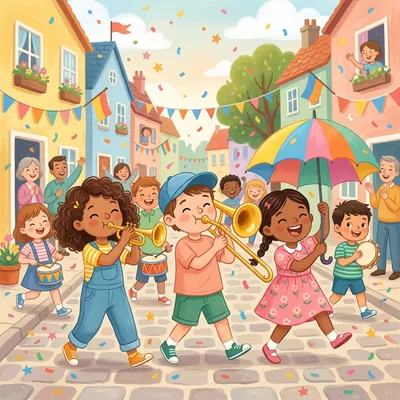
Children usually meet it as a marching song, and it works perfectly as one. Four beats, one line repeated three times, a different line in the third slot. A group can learn it in a single pass and then walk, clap, or stamp to it for as long as the adult can stand it.
Origins
The song grew out of a cluster of gospel pieces with similar titles that circulated in Black churches around the turn of the twentieth century. One of them, "When the Saints Are Marching In", was published in 1896 with words by Katharine Purvis and music by James Milton Black. It is a different song, and it gets confused with this one constantly, but it is not the first printing of these verses. Another relative, "When the Saints March In for Crowning", appeared in 1908.
The earliest known recording is from 1923, by the Paramount Jubilee Singers. The record label reads "When All the Saints Come Marching In", but the group sings the words we know now. The earliest known print of that same modern form came four years later, in 1927, in Edward Boatner's collection Spirituals Triumphant: Old and New, prepared in Nashville for the National Baptist Convention. Boatner made no claim to have written it. His foreword says plainly that the songs came from tradition.
A separate version with words by Luther G. Presley and music by Virgil O. Stamps was copyrighted by the Stamps-Baxter Music Company in 1937 and printed in their songbooks. That copyright covers their arrangement, not the older traditional song underneath it.
Louis Armstrong recorded it for Decca on 13 May 1938, with an arrangement by his pianist and music director Luis Russell. Armstrong was born and raised in New Orleans and had heard the song all his life. Decca was in no rush to release the record, but once it circulated it turned a church song into a jazz standard, and Armstrong kept it in his act for the rest of his career.
Meaning & Interpretation
The words describe the last judgment. Each verse borrows an image from scripture: the sun refusing to shine, the moon turning to blood, the trumpet call. Those pictures appear in the book of Revelation and in Joel and Acts, and gospel singers drew on them freely.
The line that carries the song is "I want to be in that number". The singer is not describing the scene from outside it. The singer is asking to be counted among the saved when the roll is read. Sung by congregations who had little else they could count on, that request has weight, and it is the reason the song survives the fast tempos and party arrangements laid over it since.
What is a jazz funeral?
A jazz funeral is a New Orleans burial procession led by a brass band, and it has two halves. On the way to the cemetery the band plays slow dirges and hymns, and mourners follow in a heavy shuffle known locally as the slow drag. After the body is interred, the grand marshal signals that the dead have been released, a moment often called cutting the body loose. The band then switches to fast, swinging music, the crowd claps and dances, and umbrellas and handkerchiefs go up. "When the Saints Go Marching In" belongs to that second half, the walk back.
Who wrote When the Saints Go Marching In?
No one knows, and it probably had no single author. The song took shape in the early 1900s out of several similar gospel songs and was carried by singers before it was written down. Various people later copyrighted their own arrangements, including the Stamps-Baxter version of 1937, but those claims cover particular settings rather than the traditional song itself.
What does "I want to be in that number" mean?
It means the singer wants to be counted among the saints when they are called. "That number" is the company of the saved, the group whose names are on the list. The phrase is a request to be included, which is why the same four words come back at the end of every verse no matter which image the verse opens with.
Related Nursery Rhymes



Lyrics from nurseryrhymes.info