

Here We Go Round the Mulberry Bush


Lyrics
Here we go round the mulberry bush,The mulberry bush,The mulberry bush.Here we go round the mulberry bushOn a cold and frosty morning.
This is the way we wash our face,Wash our face,Wash our face.This is the way we wash our faceOn a cold and frosty morning.
This is the way we comb our hair,Comb our hair,Comb our hair.This is the way we comb our hairOn a cold and frosty morning.
This is the way we brush our teeth,Brush our teeth,Brush our teeth.This is the way we brush our teethOn a cold and frosty morning.
This is the way we put on our clothes,Put on our clothes,Put on our clothes.This is the way we put on our clothesOn a cold and frosty morning.
Here we go round the mulberry bush,The mulberry bush,The mulberry bush.Here we go round the mulberry bushOn a cold and frosty morning.
History and Meaning
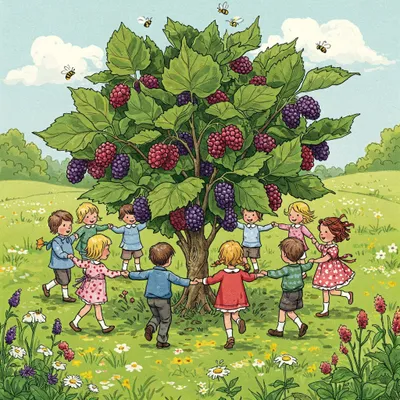
Children circle hand in hand around an imaginary mulberry bush, then break off to mime the morning routine: washing faces, combing hair, brushing teeth, pulling on clothes, all "on a cold and frosty morning." It is a singing game that doubles as a rehearsal for getting ready in the morning.
Origins
The song is cataloged as number 788 in the Roud Folk Song Index. While the singing game was likely played earlier in oral traditions, it was first documented in print in 1842. The prominent English antiquarian James Orchard Halliwell included it in his collection The Nursery Rhymes of England. Similar circle games and songs have been recorded across several European countries, suggesting a shared folklore tradition.
Meaning & Interpretation
The lyrics are structured to help children learn daily routines and chores. In each verse, children mimic activities like washing their faces, combing their hair, brushing their teeth, and putting on their clothes. The recurring refrain, "On a cold and frosty morning," provides a rhythmic structure that keeps the game moving.
Two major historical theories exist regarding the origin of the lyrics. The most popular theory connects the song to HM Prison Wakefield in West Yorkshire. According to local lore, female inmates were exercised in a courtyard containing a mature mulberry tree, and their children would sing the song while walking around it. While a real mulberry tree did exist at the prison until it died from disease between 2017 and 2019, historians have not found contemporary written records to prove the connection. Another theory suggests the rhyme refers to Britain's failed attempts to establish a silk industry in the seventeenth century, as mulberry trees (needed for silkworms) struggled to grow in the cold British climate.
What is the history of the Mulberry Bush nursery rhyme?
The song was first recorded in print in 1842 by James Orchard Halliwell. It is a traditional English singing game where children act out daily routines while dancing in a circle.
Is the Mulberry Bush song connected to a prison?
A local legend in Yorkshire claims that female inmates at HM Prison Wakefield sang the rhyme while exercising around a mulberry tree in the prison yard. However, no direct historical evidence supports this claim.
Music Video
If the player is unavailable, watch this video on YouTube.
Free Printable Coloring Page
Print this Here We Go Round the Mulberry Bush coloring sheet for free and let little ones bring it to life with crayons or pencils.
Full-resolution PNG · Fits the paper size selected in your print dialog · Personal and classroom use

Related Nursery Rhymes






Lyrics from nurseryrhymes.info