

I Had a Little Bird (In-Flu-Enza)

Lyrics
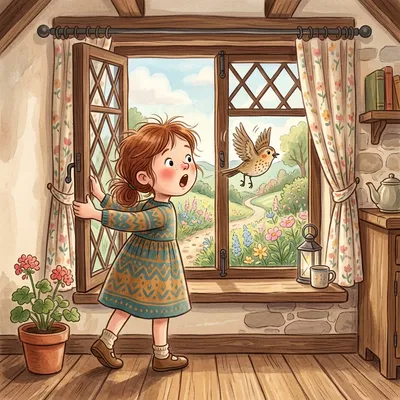
I had a little bird,Its name was Enza.I opened the window,And in flew Enza.
History and Meaning
Four lines and a single joke: say "in flew Enza" at speed and you have said "influenza". Children in Britain and the United States chanted it while skipping rope and bouncing balls against walls in 1918 and 1919, the two years of the worst influenza pandemic in recorded history. That is the whole of the rhyme's fame, and it makes this one of very few nursery rhymes whose link to a specific disaster is documented while the disaster was happening rather than guessed at long afterwards.
Origins
The wordplay is older than 1918. A longer version was printed in 1894 in Our Paper, a magazine produced at the Massachusetts Reformatory in Concord: "There was a little girl, and she had a little bird, / And she called it by the pretty name of Enza; / But one day it flew away, but it didn't go to stay, / For when she raised the window, in-flu-Enza." Influenza outbreaks were a routine part of life in that period, and a serious pandemic had circled the globe in 1889 and 1890, so a pun on the word was already in circulation.
What 1918 did was cut the verse down. The version that survives is four short lines with the pun on the last one, which is exactly the shape a skipping rhyme needs: enough beats for a turning rope, a punchline that lands on the final swing. People who were children during the outbreak recalled singing it for the rest of their lives, and it appears repeatedly in oral histories, memoirs and local newspaper reminiscences on both sides of the Atlantic.
The pandemic behind it spread worldwide between the spring of 1918 and 1920. Record keeping was patchy across much of the world, so the death toll is an estimate rather than a count. The figure most commonly cited is at least 50 million people worldwide, with some researchers arguing the true number was closer to 100 million. Around 500 million, roughly a third of the world's population at the time, are estimated to have been infected. In the United States about 675,000 people died. One feature set the outbreak apart from ordinary flu: it killed an unusually high proportion of healthy adults aged roughly 20 to 40, rather than falling mainly on the very young and the very old.
Meaning & Interpretation
The rhyme never mentions illness. On the surface it is about a child, a pet bird with an odd name, and an open window. All the meaning sits in the sound of the fourth line, and it arrives the instant a listener hears it said aloud rather than read.
The window is worth a note, since fresh air and ventilation were among the few measures thought to help in 1918. But the window was already there in the 1894 version, where it exists only to let the bird in and make the pun work. Reading it as public health advice is a later idea, not something the verse supports.
Children's play takes in whatever is happening around it. Skipping and ball-bouncing rhymes are built to be shouted in rhythm, and they absorb wars, monarchs, illness and local gossip without any particular reverence for the subject. Chanted in a street in 1918, this one was not trying to explain the pandemic or to soften it. It was a good pun on a word every child was hearing several times a day, set to a rope.
It is worth contrasting it with "Ring a Ring o' Roses", which is often said to describe the plague. That claim only appears in the twentieth century, centuries after the events it supposedly records, and folklorists reject it. "I Had a Little Bird" is the reverse case. The connection is not an interpretation applied afterwards; it is the plain circumstance in which people remember singing it.
What does "in flew Enza" mean?
It is a pun on the word influenza. Spoken at normal speed, "in flew Enza" and "influenza" sound identical. The rhyme invents a pet bird named Enza so that the final line can describe the bird flying in through an open window and, in the same breath, describe someone catching the flu. That double meaning is the entire point of the verse, and it works only out loud.
Is the rhyme really about the 1918 flu pandemic?
Yes, in the sense that matters: children sang it during the 1918 to 1919 outbreak, and that is when it became widely known. The joke itself is older, since a longer version was already in print in 1894. The 1918 pandemic did not create the pun so much as adopt it, shorten it, and spread it much further than it had ever gone before.
How did children sing it?
As a skipping rhyme and a ball-bouncing rhyme, chanted rather than sung to a fixed tune. The four short lines fit the rhythm of a turning rope, with the pun landing on the last beat. Wording varies between recollections, most often between "its name was Enza" and "I called it Enza", which is normal for verses passed on by ear in playgrounds rather than printed in books.
Why was the 1918 flu called Spanish flu?
Because of wartime censorship, not because it started in Spain. Spain was neutral in the First World War and its newspapers reported the epidemic openly, while the combatant nations suppressed news that might damage morale or reveal weakness. Readers elsewhere saw detailed coverage coming out of Spain and very little from anywhere else, and the name stuck. Historians do not consider Spain the source of the outbreak.
Related Nursery Rhymes






Lyrics from nurseryrhymes.info