
Nursery Rhymes About Ireland
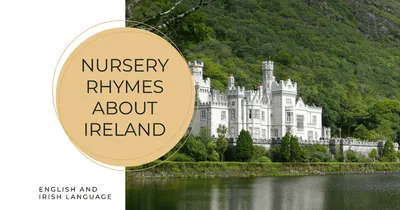
Ireland's children's songs did not come from books. They came from kitchens, street corners and fair days, and they were sung long before anyone thought to write them down. What survives is a mix: ballads in English that children adopted as their own, skipping and knee-bouncing rhymes from Dublin and Belfast, and a separate tradition of songs in Irish that is still taught in schools today.
Below are the Irish songs and rhymes on this site, each with full lyrics, the story behind it and where it was first collected. The English-language ones come first, followed by the Irish-language rhymes.
Cockles and Mussels (Molly Malone)
Dublin's unofficial anthem, sung for the fishmonger who wheeled her barrow through streets broad and narrow. First published in Boston in 1876; her statue has stood in Dublin since 1988.
I'll Tell Me Ma
The belle of Belfast city, and a skipping and circle game before it was ever a folk standard. Collected by Alice Gomme in 1898, with singers swapping Belfast for Dublin, Glasgow or London.
How Many Miles to Dublin?
A knee-bouncing rhyme that trots a toddler all the way to the capital and drops them at the end. It is the Irish cousin of How Many Miles to Babylon, with Dublin swapped in for the far-off city.
The Rattlin' Bog
The cumulative song that beats everyone in the end: bog, tree, branch, twig, nest, egg, bird, feather, unwound backwards and faster each verse until somebody drops a link.
The Gartan Mother's Lullaby
A cradle song with a paper trail: Herbert Hughes noted the air in north Donegal in 1903 and Joseph Campbell wrote the words, complete with a fairy queen and a sprite crossing a starlit bog.
Michael Finnegan
Built never to end. Every verse hands poor Michael a small disaster and then loops straight back to "begin again", usually to a fast polka rhythm and a groan from the grown-ups.
Irish-Language Rhymes (As Gaeilge)
Ireland's oldest children's songs are in Irish, and they are far from museum pieces: these are the songs taught in Gaelscoileanna and naíonraí today. Each page below has the original Irish, a line-by-line English translation, pronunciation help and notes on the grammar, so they work whether you are singing with a child or learning the language yourself.
- Báidín Fheidhlimí Feidhlim's Little Boat
- An Poc ar Buile The Mad Puck Goat
- Dúlamán Seaweed
- Bó Bheag Little Cow
- Beidh Aonach Amárach There'll Be a Fair Tomorrow
- An Mhaighdean Mhara The Mermaid
- Táimse im' Chodladh I Am Asleep
- Im Shuí Im Luí Sitting and Lying
- Cailín na Gruaige Doinne The Girl with the Brown Hair
- Cuachán nan Craobh The Cuckoo in the Grove
There are more where these came from. Songs such as An Maidrín Rua, Dilín ó Deamhas, An Spailpín Fánach and Buachaill ón Éirne are still sung in Irish classrooms and sessions, and we are adding to the collection; if there is one you would like to see, tell us which.
Why Ireland Has Fewer Rhymes in Print
England, and London especially, got a head start on paper. Tommy Thumb's Pretty Song Book was printed in London around 1744 and John Newbery's Mother Goose's Melody followed in 1765, fixing dozens of English verses in type while they were still being sung. Nothing comparable was happening in Ireland at the time.
Irish children's songs stayed where they had always been, in the mouths of the people who sang them. Many of the best were in Irish, a language the eighteenth century collectors in London had no interest in and no ability to record. When the rhymes finally were gathered, in Alice Gomme's The Traditional Games of England, Scotland and Ireland (1894 and 1898) and in collections like Songs of Uladh (1904), they arrived a century and a half later than their English counterparts.
That gap flatters English rhymes and undersells Irish ones. The songs were there all along; the printing press simply got to them last.
Frequently Asked Questions
What is the most famous Irish nursery rhyme?
"Cockles and Mussels", better known as "Molly Malone", is the best known children's song to come out of Ireland. It is treated as the unofficial anthem of Dublin, where a bronze statue of Molly was put up in 1988 for the city's millennium.
Are there nursery rhymes in the Irish language?
Yes. Songs like "Báidín Fheidhlimí", "Bó Bheag" and "An Poc ar Buile" are still taught in Gaelscoileanna and naíonraí across Ireland. We publish ten of them with the original Irish, a line-by-line English translation and grammar notes.
Why are there fewer nursery rhymes about Ireland than about London?
The first printed rhyme collections were made in London in the 1740s, so English verse got written down early. Irish children's songs stayed in the oral tradition much longer, and many of the best were in Irish, a language the eighteenth century English collectors did not gather.
Where to Go Next
- Irish Nursery Rhymes (Amhráin Pháistí): all ten Irish-language songs with original lyrics, translations and grammar notes for learners.
- Nursery Rhymes About London: the other city with a songbook of its own, from Bow bells to Drury Lane.
- Nursery Rhymes Around the World: how children's songs work in ten other languages and traditions.
- All Languages: browse rhymes in Irish, French, Spanish, Hindi, Italian, Tagalog, Urdu and more.