
The Rattlin' Bog

Lyrics
Chorus
Ho, ro, the rattlin' bog, the bog down in the valley-o,Ho, ro, the rattlin' bog, the bog down in the valley-o.
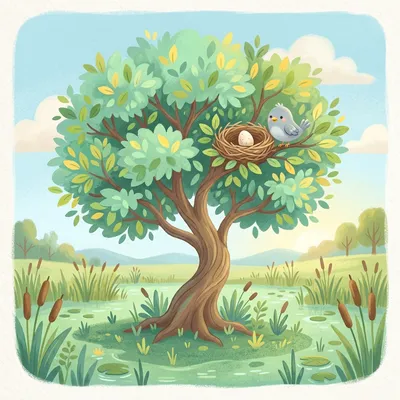
Now in that bog there was a tree,A rare tree, a rattlin' tree,With the tree in the bog,And the bog down in the valley-o.
And on that tree there was a branch,A rare branch, a rattlin' branch,With the branch on the tree,And the tree in the bog,And the bog down in the valley-o.
And on that branch there was a twig,A rare twig, a rattlin' twig,With the twig on the branch,And the branch on the tree,And the tree in the bog,And the bog down in the valley-o.
And on that twig there was a nest,A rare nest, a rattlin' nest,With the nest on the twig,And the twig on the branch,And the branch on the tree,And the tree in the bog,And the bog down in the valley-o.
History and Meaning
The point of "The Rattlin' Bog" is that it gets harder every verse. Each new verse puts one small thing inside the thing before it, and then the singers have to unwind the whole chain backwards before they are allowed to stop. By the sixth or seventh round you are reciting feather on the bird, bird in the egg, egg in the nest, nest on the twig, twig on the branch, branch on the tree, tree in the bog, and the bog down in the valley. Drop a link and you are out.
The usual chain runs bog, tree, branch, twig, nest, egg, bird, feather, and some singers keep going with a flea on the feather. The chorus comes back between verses, which is the only place anyone gets to breathe. Groups start it slowly and speed up with each verse, so the last few turn into a tongue-twisting sprint. That acceleration is the whole game. It is why the song survives as a party piece in Irish sessions, scout halls and school assemblies rather than as a concert number.
Origins
The song is catalogued as Roud 129, a number it shares with a large family of cumulative songs collected under titles including "The Everlasting Circle", "The Tree on the Hill", "Down in the Lowlands" and the Appalachian The Green Grass Grew All Around. Roughly 180 versions have been recorded from oral tradition in English alone, and relatives turn up in Welsh, Breton, German, French, Italian and Yiddish. The Welsh "Y Pren ar y Bryn", meaning "The Tree on the Hill", is the same idea in another language.
Print history is patchy, which is why no single date fits the song. A tune called "March to the Battlefield" in Edward Riley's flute collections is often named as the earliest printed relative of the melody. In 1877 the folk song collector Marianne Harriet Mason published a version as "Green Grass Grows all Around" in her book Nursery Rhymes and Country Songs. The Irish bog wording that most people sing today is a nineteenth century form of a much older song idea, so the family is far older than any of these printings.
Meaning & Interpretation
"Rattlin" is not about noise. In nineteenth century British and Irish usage, rattling worked as a slang intensifier meaning splendid, first-rate or lively, the sense preserved in phrases like "a rattling good time" and still listed in dictionaries as "extraordinarily good: splendid". So the bog is a fine bog, and the tree is a fine tree. People who assume the bog is shaking or clattering are reading a much later meaning back into the word.
There is no story here and no moral. A bog is simply the peat ground that covers a great deal of Ireland, and the song uses it as a starting point for a zoom lens: the singer moves from a whole landscape down to one feather on one bird, one step at a time. What the song actually trains is memory and breath control under pressure, which is a real skill dressed up as a joke.
What does "rattlin" mean in The Rattlin' Bog?
It means splendid or fine, not noisy. "Rattling" was a common informal intensifier in nineteenth century English and Irish speech, used the way "cracking" or "brilliant" might be used now, and dictionaries still record the sense as "extraordinarily good: splendid". The same word is applied to every item in the chain, so the tree, the branch, the twig and the nest are all described as fine specimens.
How do you sing The Rattlin' Bog with a group?
Sing the chorus first so everyone has the tune, then add one item per verse and recite the full chain backwards at the end of each verse before returning to the chorus. Start slowly enough that the youngest singers can keep up, then increase the speed a little with every new item. Most groups keep the chain to eight links, ending at the feather. Pointing at each item on your fingers as you go helps younger children hold the order.
Is The Rattlin' Bog related to The Green Grass Grew All Around?
Yes. Both belong to Roud 129, the same cumulative song family, and they share the nesting structure of tree, branch, twig, nest, egg and bird. The Green Grass Grew All Around is the North American form, usually set on a hill or in a woods rather than a bog, with its own refrain. The two are best understood as regional versions of one old song rather than separate compositions.
How many verses does The Rattlin' Bog have?
There is no fixed number. Eight is the most common, following bog, tree, branch, twig, nest, egg, bird and feather, but singers freely add a flea on the feather, or a hair, or whatever the group can still manage to recite. Because every verse repeats everything before it, the song tends to end when the chain outruns the singers rather than at a set point.
Related Nursery Rhymes



Lyrics from nurseryrhymes.info