
Nursery Rhymes Around the World
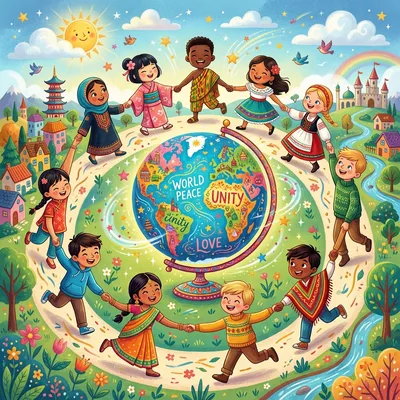
Mother Goose may rule the English-speaking nursery, but every culture has its own songbook. Cross a border and the language changes while the ingredients rarely do: strong rhythm, heavy repetition, a tune a small child can catch in one hearing. Those are the features that make a song stick, in any language.
Here is one song from each of the ten languages on this site. Every page carries the original lyrics, a line-by-line English translation, vocabulary notes and the history behind the words.
Frère Jacques
The round the whole world sings, about a monk who has slept through his duty to ring the morning bells. Sung in four overlapping parts, it teaches children to hold their own line against everyone else's.
Los Pollitos Dicen
The Little Chicks Say: perhaps the best-loved lullaby in Latin America, in which a mother hen feeds her chicks and shelters them from the cold until they fall asleep.
Alle meine Entchen
All My Little Ducklings, with their heads in the water and their tails in the air. German children's songs lean heavily on nature and animals, and this is the one nearly every child learns first.
Giro Girotondo
Italy's ring-around game: children circle holding hands and drop to the ground at the end, the same shape as Ring a Ring o' Roses and every other circle chant in Europe.
Báidín Fheidhlimí
Feidhlim's Little Boat sets out for Tory Island and does not come back. A staple of Irish-language classrooms, and a good first song for anyone learning the language.
Machli Jal ki Rani Hai
Fish Is the Queen of Water: four short lines that every Indian child knows, and a first lesson about living things needing the right home to survive in.
Chidiya Rani
Little Bird Queen, a gentle question-and-answer poem asked of a bird, sung across Urdu and Hindi-speaking households in much the same words.
Bahay Kubo
Nipa Hut names eighteen vegetables growing around a small stilt house, so Filipino children learn the contents of a kitchen garden by singing their way through it.
O Balão do João
João's Balloon rises up and up and never comes down. A short, repetitive Brazilian favourite, often sung with arms lifting higher on every verse.
Калинка (Kalinka)
Written in 1860 and now the best-known Russian folk song in the world, built on a chorus that starts slow and accelerates until the singers can barely keep up.
The Ten Languages, Language by Language
French 4 rhymes
French comptines are known for their melodies and, like English rhymes, their long histories. Sur le Pont d'Avignon reaches back to the 1400s, which makes it the oldest rhyme we can put a date to anywhere on this site.
- Sur le Pont d'Avignon - the medieval bridge, and a dancing game
- Alouette - a cheerful tune about plucking a lark, feather by feather
- Ah! Vous dirai-je, maman - the 1761 melody that became Twinkle, Twinkle
Spanish 10 rhymes
Spanish-language songs travel between Spain and Latin America and pick up local versions as they go. Many are built for clapping, counting or a birthday, and some began life as adult songs that were cleaned up for children.
- Un Elefante Se Balanceaba - a cumulative counting song about elephants on a spider web
- La Cucaracha - satire from the Mexican Revolution, sanitised into a nursery tune
- Las Mañanitas - the birthday song sung at dawn in Mexico
German 3 rhymes
German Kinderlieder are practical: they name animals, count things, or walk a child through a task from start to finish. The tunes are simple enough that they turn up in beginner piano books everywhere.
- Backe, backe Kuchen - a baking song that lists the ingredients for a cake
- Hänschen Klein - little Hans leaves home, and comes back in the softer 1860 ending
Italian 6 rhymes
Italian filastrocche run from tiny bedtime verses to songs the whole country sings. Several are local cousins of rhymes you already know, which makes them a neat way to hear the same tune in another language.
- Fra Martino Campanaro - the Italian Frère Jacques, sung as the same round
- Stella Stellina - a short, calm lullaby about the first star of the night
- Ambarabà Ciccì Coccò - nonsense words used to pick who is "it"
Irish 10 rhymes
Irish amhráin pháistí are taught in Gaelscoileanna and naíonraí across Ireland, so they are living classroom songs rather than heritage pieces. Every page includes grammar notes for learners.
- Dúlamán - a work song about harvesting seaweed off the cliffs
- An Poc ar Buile - the mad puck goat, and a very fast chorus
- Nursery Rhymes About Ireland - the English-language Irish songs, from Dublin to Donegal
Hindi 9 rhymes
Hindi rhymes lean towards animals, food and gentle moral lessons, and several of the best known come from Indian cinema rather than the folk tradition, which is why parents and children often learn them from the same source.
- Lakdi Ki Kathi - the wooden horse, from the 1983 film Masoom
- Akkad Bakkad Bambe Bo - the counting-out chant for choosing who is "it"
- Chanda Mama Dur Ke - Uncle Moon, far away, feeding a child from the sky
Urdu 4 rhymes
Urdu nursery poems share much of their vocabulary and several whole songs with Hindi, so a child in Karachi and a child in Delhi may be singing near-identical words in a different script.
- Do Chuhe The - two mice, one dinner, and a lesson in sharing
- Bulbul Ka Baccha - the nightingale's child, a classic recitation piece
Tagalog 7 rhymes
Filipino children's songs are full of village life: gardens, butterflies, rice fields and hand-clapping nonsense. Several carry a sly adult joke under the surface that children only get years later.
- Pen Pen de Sarapen - a hand-clapping rhyme mixing mock-Spanish and Tagalog
- Leron Leron Sinta - a courtship song turned playground favourite
Portuguese 4 rhymes
Portuguese and Brazilian songs for children are short, circular and easy to act out. One of them has been quietly rewritten in recent decades to be kinder to the cat in it.
- Atirei o pau ao gato - the old version and the gentler modern rewrite
- O meu chapéu tem três bicos - the three-cornered hat, with an action dropped each verse
Russian 1 rhyme
Our Russian collection is just getting started, and begins with the song most people outside Russia can already hum.
- All languages - browse everything by language, and tell us what to add next
The Same Song in Four Languages
Some rhymes are not translations of each other so much as the same idea turning up everywhere. "Frère Jacques" is "Fra Martino Campanaro" in Italian and "Bruder Jakob" in German, sung as the same four-part round. The circle-and-fall game is "Ring a Ring o' Roses" in English, "Giro Girotondo" in Italian and "Ringel, Ringel, Reihe" in German. And the melody of "Twinkle, Twinkle, Little Star" is a French tune from 1761, "Ah! Vous dirai-je, maman", which also carries the alphabet song.
Counting-out chants are the clearest case of all. "Eeny, meeny, miny, moe", "Akkad Bakkad Bambe Bo", "Ambarabà Ciccì Coccò" and "Pen Pen de Sarapen" all do the same job with the same weapon: strings of nonsense syllables chosen for rhythm rather than meaning, because a chant needs a beat far more than it needs sense.
Why Sing Rhymes from Other Languages?
A child does not need to understand a word of Tagalog to enjoy "Bahay Kubo". Young ears are still open to sounds and rhythms that adult ears have learned to filter out, and unfamiliar vowel sounds, scales and stress patterns are easier to take in before about seven than after.
There is a plainer reason too. Singing another family's song is the least preachy form of introduction there is: it says that this is what children somewhere else find funny, or soothing, or worth learning, and leaves the child to notice how much of it they recognise.
Where to Go Next
- Browse by Language: every international rhyme on the site, grouped by language.
- The Oldest Nursery Rhymes: topped by a French round from the 1400s.
- Nursery Rhymes About Ireland: Irish songs in both English and Irish.
- The History of Nursery Rhymes: how oral folk song became the printed nursery canon.