
Oh Soldier, Soldier, Won't You Marry Me

Lyrics
"Oh, soldier, soldier, won't you marry me,With your musket, fife and drum?""Oh no, sweet maid, I cannot marry thee,For I have no coat to put on."
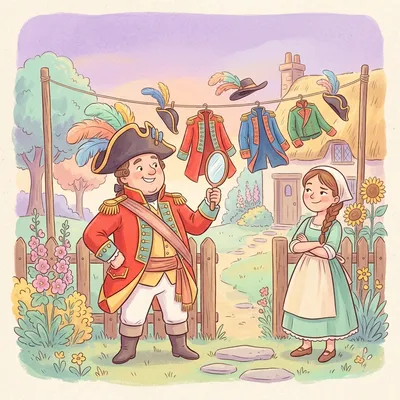
So off she ran to the grandfather's chest,And she brought him a coat of the very, very best,And the soldier put it on.
"Oh, soldier, soldier, won't you marry me,With your musket, fife and drum?""Oh no, sweet maid, I cannot marry thee,For I have no hat to put on."
So off she ran to the grandfather's chest,And she brought him a hat of the very, very best,And the soldier put it on.
"Oh, soldier, soldier, won't you marry me,With your musket, fife and drum?""Oh no, sweet maid, I cannot marry thee,For I have no boots to put on."
So off she ran to the grandfather's chest,And she brought him boots of the very, very best,And the soldier put them on.
"Oh, soldier, soldier, won't you marry me,With your musket, fife and drum?""Oh no, sweet maid, I cannot marry thee,For I have no gloves to put on."
So off she ran to the grandfather's chest,And she brought him gloves of the very, very best,And the soldier put them on.
"Oh, soldier, soldier, won't you marry me,With your musket, fife and drum?""Oh no, sweet maid, I cannot marry thee,For I have a wife of my own."
History and Meaning
The soldier leaves this song wearing a coat, a hat, a pair of boots and a pair of gloves, every one of them fetched for him by a woman who wants to marry him. Then he tells her he is already married. He has given her nothing at all.
The joke only lands if you watch the pattern build. Each round runs the same way. She asks, he refuses, and the refusal is never about her. It is always about a missing item of clothing, which sounds like a problem she can solve. So she solves it. She runs to the grandfather's chest, brings back the best one in there, and the soldier puts it on. Then she asks again, and he has thought of something else he lacks. Verse by verse he is assembled into a fully dressed man at her family's expense, and the audience starts to see where this is going several rounds before she does. By the last verse the listeners are usually laughing at the setup rather than the punchline, because they got there first.
Origins
The song is English and traditional, with no known author or composer. Folklorists file it as Roud 489, and it also travels under the shorter titles "Soldier, Soldier" and "Soldier John". Print records go back to the nineteenth century: William Wells Newell included it in Games and Songs of American Children in 1883, a landmark collection of what American children were actually singing in the street rather than what adults thought they should sing.
It was collected repeatedly in the early twentieth century, which is the usual sign that a song was already widespread rather than newly written. Cecil Sharp noted words and tune in the Southern Appalachians in 1917, and versions turned up many times over in Tennessee and North Carolina during the same period. Anne Gilchrist collected it in Scotland in 1919, and Seamus Ennis recorded it in Ireland. Versions vary in the order and number of garments, and some singers add a shirt, a cravat or a sword. The final line stays put.
It has kept two separate lives since. Folk clubs sing it as a comic ballad, and primary schools sing it as an easy call-and-response number, usually with the verse count trimmed so the lesson ends on time.
Meaning & Interpretation
This is a swindle song, and the singers are on the swindler's side. Nobody is hurt in any lasting way, nobody weeps at the end, and the tune stays bright throughout. The woman loses some clothes belonging to a relative who may or may not have been consulted. That detail about the grandfather's chest does a lot of quiet work, because she is not even giving away her own property to win him.
Some singers hear it as a joke at the expense of soldiers, who had a longstanding reputation in ballad tradition for making promises in one town and keeping a wife in another. Others treat it as a joke on gullibility in general, with the uniform as set dressing. The song itself takes no side and never moralises. It simply stops on the reveal and leaves the laugh sitting there.
The refrain "with your musket, fife and drum" places him as a marching soldier of the era of fife-and-drum infantry, and the phrase is worth explaining once to a class rather than letting it slide past as nonsense words.
How do you sing this as a two-group song?
Split the room in half. One group sings only the woman's question, the same four lines every time, and the other group sings the soldier's refusal, changing one word each round. A teacher or a third small group can take the narrating verse in the middle, the one that begins "So off she ran". The repetition means neither side has much to memorise, and the swap keeps attention up. It also sets up the ending well, because the soldier's group gets to deliver the last line while the other half realises what has happened.
What happens at the end of Oh Soldier, Soldier, Won't You Marry Me?
The soldier admits he already has a wife, after accepting every garment she brought him. He never lied outright in the earlier verses, which is part of the joke. He genuinely had no coat, no hat, no boots and no gloves, and he said so. He just left out the one fact that would have ended the conversation before it started.
What does "musket, fife and drum" mean?
A musket is a shoulder-fired gun carried by infantry before rifles replaced it. The fife is a small high-pitched flute, and together with the drum it provided the marching music and the signal calls that kept a unit in step and passed orders across a noisy field. The three words together are shorthand for a common foot soldier on the march rather than an officer.
How many verses should we sing?
As many as the group has patience for. The song is cumulative in shape but not in length, since each round replaces the previous garment rather than stacking on top of it, so verses can be added or dropped freely without breaking anything. Three or four items plus the final reveal is enough for the pattern to register with young children. Longer versions with six or eight garments work better with a group that already knows the punchline and wants to draw out the wait.
Related Nursery Rhymes




Lyrics from nurseryrhymes.info