
Sally Go Round the Sun


Lyrics
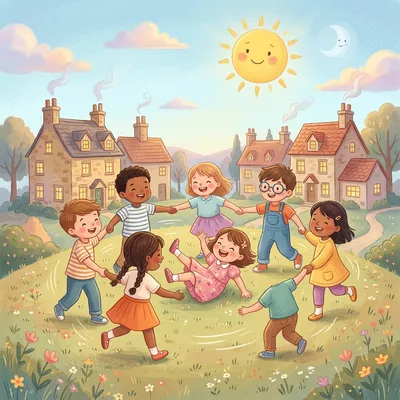
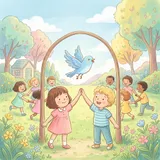
Everyone holds hands and walks round in a ring.
Sally go round the sun,Sally go round the moon,Sally go round the chimney-potsOn a Sunday afternoon.Boom!
On "boom!" the ring breaks and everybody drops to the floor.
History and Meaning
The whole song is four lines long, and the word that matters is the one at the end. A ring of children shuffles round holding hands, the verse runs out, somebody shouts "boom!", and the entire circle collapses on the floor. Everything before that is a wind-up. Toddlers who cannot yet manage the words will still arrive on time for the fall.
That shared drop puts the game in the same family as Ring a Ring o' Roses, which is built on exactly the same shape: a circle, a short verse, and an agreed moment when everyone goes down together. Sally is the shorter and blunter of the two, which makes it useful with very small children who lose patience partway through a longer song.
Origins
The earliest printed record is not the sun version at all. Alice Bertha Gomme included the game in the second volume of "The Traditional Games of England, Scotland, and Ireland" in 1898, under the title "Sally go Round the Moon", from Deptford in Kent. The form almost everyone sings now, with the sun first and the chimney-pots in the third line, spread later and mainly in North America.
Gomme is the reason a great deal of this material survives. She published her two volumes in 1894 and 1898, describing roughly 800 children's games gathered with the help of seventy-six correspondents around Britain and Ireland, and she was the first scholar to treat children's games as a distinct branch of folklore rather than as background noise. Plenty of the singing games still played in schools reach us through her pages and nowhere else.
The North American attachment to the song is easy to trace. The Canadian folklorist Edith Fowke called her 1969 collection of about 300 children's songs, rhymes and games "Sally Go Round the Sun", which tells you how ordinary the sun form had become on that side of the Atlantic by then. Wording still moves around. The last line turns up as "on a Saturday afternoon" and as "every afternoon", and the shout at the end is sometimes "bump!" or "whoops!" instead of "boom!".
Meaning & Interpretation
Nobody has found a hidden story underneath this one, and the song does not appear to need one. The interest is in the sequence. Sally circles the sun, then the moon, then the chimney-pots, so the verse travels from the largest things a child knows down to the roofline of the street outside the front door. It is a joke about scale, told without any explanation.
Chimney-pots are the concrete detail worth pausing on. They are the fired clay pots fitted on top of a chimney stack to improve the draw, and on a row of Victorian terraced houses they stand along the roof in a line. For a child in a nineteenth century English town they were the most familiar landmark overhead, so the rhyme is measuring the sky against the view from the pavement. Sunday afternoon fits the same world: the free part of the week, when there was time to play in the street.
The fall is the payoff. Repetition, a fixed ending, and a small controlled shock the child can see coming, over and over.
Was it originally the moon?
The oldest known printed version is "Sally go Round the Moon", recorded by Alice Bertha Gomme at Deptford, Kent, and published in 1898. The familiar "Sally go round the sun" opening came later and took hold chiefly in North America. Most versions sung today keep both anyway, with the sun in the first line and the moon in the second, so the older title survives inside the newer song.
How do you play Sally Go Round the Sun?
Children join hands in a ring and walk, skip or shuffle round in one direction while singing the verse. On the final "boom!" everyone lets go and drops, jumps or falls to the ground together, then stands up and starts again, usually turning the other way. There is no winner and nobody goes out, which is why it works with very young players.
Is it the same game as Ring a Ring o' Roses?
No, they are separate songs with different words and tunes, but they are close relatives in structure. Both are circle games for young children that end with the whole ring going down at a fixed moment. Groups often play them one after the other for that reason.
What are chimney-pots?
A chimney-pot is the clay or earthenware pipe fitted to the top of a chimney to help smoke draw upward. Rows of them along the roofs of terraced housing were an everyday sight in British towns when the rhyme was collected, which is why they sit so naturally beside the sun and the moon in the verse.
Related Nursery Rhymes

Lyrics from nurseryrhymes.info