
There Was a Crooked Man


Lyrics
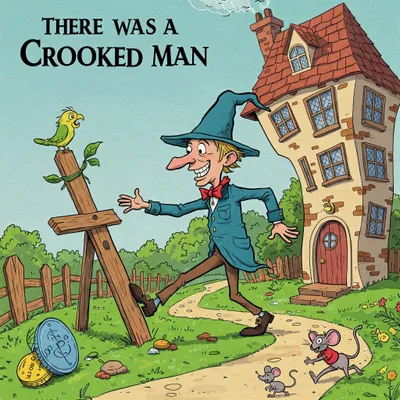
There was a crooked man and he went a crooked mile,He found a crooked sixpence against a crooked stile;He bought a crooked cat, which caught a crooked mouse,And they all liv'd together in a little crooked house.
History and Meaning
Everything in this rhyme is crooked: the man, his mile, his sixpence, his stile, his cat, his mouse, and his little house. The repeated word is the whole charm, though some read a real history into it, a "crooked" border treaty between England and Scotland in the 1640s.
Origins
The earliest documented printed version of the rhyme was published in 1842 by the antiquarian James Orchard Halliwell in his pioneering collection, The Nursery Rhymes of England. While the written record begins in the mid-nineteenth century, folklore scholars agree that the song existed in oral tradition much earlier.
Meaning & Interpretation
Folklore researchers have proposed two main theories regarding the origin of the rhyme. The first theory suggests the song was inspired by the medieval town of Lavenham in Suffolk, England. Renowned for its distinctive, crooked half-timbered houses that lean at unusual angles due to wet timber drying after construction, the town's appearance matches the rhyme's setting. The second theory connects the "crooked man" to Scottish General Sir Alexander Leslie during the Bishops' Wars in the reign of King Charles I. Under this political interpretation, the "crooked stile" represents the border between England and Scotland, while the "crooked house" represents the uneasy political alliance that formed between the two nations. However, many scholars view the rhyme as simple nonsense folklore.
What is the meaning of There Was a Crooked Man?
The rhyme is a piece of traditional nonsense verse about a crooked man who lives in a crooked house with his crooked pets. It is used as a rhythmic chant for children, though some historians suggest it may have started as a political satire about English and Scottish relations.
Is the Crooked Man based on a real person?
One popular historical theory suggests the "crooked man" represents Scottish General Sir Alexander Leslie, who negotiated an alliance between England and Scotland in the seventeenth century. However, there is no definitive historical proof, and many folklorists believe the rhyme was inspired by the leaning houses of Lavenham, Suffolk.
Music Video
If the player is unavailable, watch this video on YouTube.
Related Nursery Rhymes


Lyrics from nurseryrhymes.info