

The Wind Blows High
Lyrics
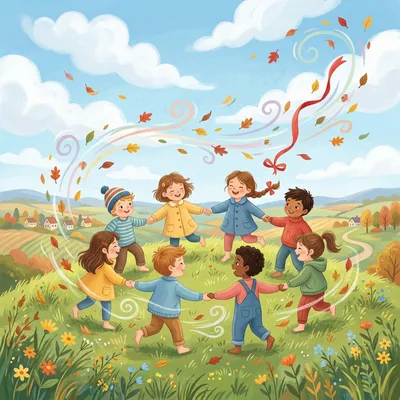
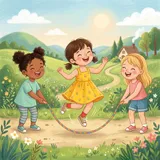
All the children join hands in a ring. One child stands in the middle. The ring walks round while everyone sings.
The wind, the wind, the wind blows high,The rain comes scattering from the sky.She is handsome, she is pretty,She is the girl of the golden city.
The ring stops. The child in the middle calls out a name.
She goes courting one, two, three,Please and tell me who is he.
Johnny Brown says he loves her,All the boys are fighting for her.Let them all say what they will,Johnny Brown loves her still.
The named child goes into the middle. The first child joins the ring, and the game begins again.
History and Meaning
A ring of children walks round one player standing in the middle, and before the song ends that player has to name somebody. The name goes straight into the words, gets sung back at them twice, and the named child takes over the centre. That is the whole game, and it has been played in more or less that shape since at least the 1880s.
Alice Bertha Gomme collected it under the plain heading "The Wind" and printed versions sent to her from all over England, Scotland and Ireland, no two quite alike. The tune is simple enough that a group picks it up in one round, which is why it survived so long without ever being written down properly.
Origins
Gomme's The Traditional Games of England, Scotland and Ireland came out in two volumes, in 1894 and 1898, and gathered roughly 800 games from correspondents across the three countries. She grouped "The Wind" with the singing games, the class of ring games that includes kiss-in-the-ring and the various wedding and wallflower games.
The song was already in America before her books went to press. W. H. Babcock recorded a version in 1886 among children in Washington, D.C., calling it "The Wind Blows Low, The Wind Blows High". Scottish collectors kept turning it up well into the twentieth century, including an Argyll text from 1901 with the line "she is the flower of the golden city". James T. R. Ritchie, who recorded and filmed Edinburgh street games in the 1950s and 1960s, took the title of his book Golden City straight from that line.
The verse shares its second half with "I'll Tell Me Ma", the song the Dubliners made popular in Britain in the 1960s. Both use "she is handsome, she is pretty" and both name a boy who loves her still. Which fed which is not settled. Collectors found them circulating side by side in the same playgrounds.
Meaning & Interpretation
The wind and the rain in the opening lines have nothing to do with anything that follows. They are weather used as a curtain-raiser, the same way "Ring a Ring o' Roses" opens with flowers. The game proper starts at "she goes courting one, two, three", and from there it is entirely about the naming.
Victorian street play was full of courtship: proposals, mock weddings, wallflowers left standing, kissing forfeits. "The Wind Blows High" belongs to that family, and the sweetheart naming was a licensed tease rather than anything more. The named boy "loves her still" whatever the other children say, which is the only plot the song has.
The "golden city" has no agreed meaning. Some collected texts say London city, some say the golden city, some name a local town. It is best treated as a phrase that drifted rather than a reference to a particular place.
How do you play The Wind Blows High?
Children join hands and form a ring, with one player standing inside it. The ring walks round singing the first verse. On the line "please and tell me who is he", the ring stops and the child in the middle names another player. Everyone then sings the final four lines with that name in them. The named child steps into the middle, the first child takes their place in the ring, and the song starts again. In a classroom the naming is normally just a way of choosing who goes next, with no sweetheart business attached, and it works exactly as well that way. A group of eight to twelve is about right. Fewer than six and the ring gets too small to walk round.
What happens at the end of the game?
There is no fixed ending, and versions differ. Most groups simply keep going until every child has had a turn in the middle, or until they stop. Some collected variants finish with the two children in the centre together, and others have the ring close in on them. Gomme printed several endings without settling on one, so any of them is defensible.
Is it the same as I'll Tell Me Ma?
No, but they overlap. "I'll Tell Me Ma" carries the same "she is handsome, she is pretty" section and the same named-boy ending, and it is played as a ring game too. The wind and rain opening belongs to this song rather than that one. Treat them as two branches off the same stock.
Related Nursery Rhymes


Lyrics from nurseryrhymes.info