
We Three Kings


Lyrics
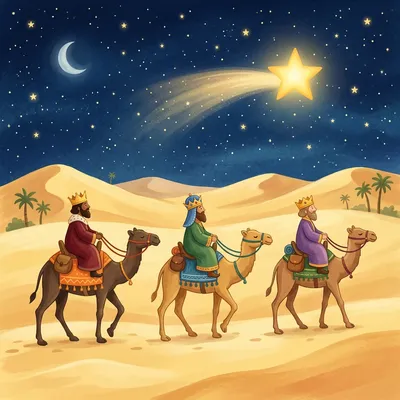
We three kings of Orient are,Bearing gifts we traverse afar,Field and fountain, moor and mountain,Following yonder star.
Chorus
O star of wonder, star of night,Star with royal beauty bright,Westward leading, still proceeding,Guide us to thy perfect light.
Born a King on Bethlehem's plain,Gold I bring to crown Him again,King forever, ceasing never,Over us all to reign.
Frankincense to offer have I,Incense owns a Deity nigh,Prayer and praising, voices raising,Worshipping God on high.
Myrrh is mine, its bitter perfumeBreathes a life of gathering gloom,Sorrowing, sighing, bleeding, dying,Sealed in the stone-cold tomb.
History and Meaning
"We Three Kings" is a carol with a teaching plan built into it. The opening verse sets three travellers on the road, and then each gift gets a verse of its own, sung by one king, spelling out what the gift is supposed to mean. Gold for a king. Frankincense for God. Myrrh for a tomb. Most Christmas carols keep the manger warm and quiet. This one walks the singer from a crown to a burial in about three minutes.
John Henry Hopkins Jr. wrote both the words and the music around 1857, which makes it one of the earliest American carols to travel widely and stay in the repertoire.
Origins
Hopkins was born in Pittsburgh in 1820, the son of the first Episcopal bishop of Vermont. He worked as a journalist and a lawyer's clerk before entering the General Theological Seminary in New York City, where he later became the school's first instructor in church music. He wrote "We Three Kings" while connected with the seminary, for a Christmas pageant, and it circulated in manuscript among friends and family for several years before he printed it.
The carol was published in his own collection, Carols, Hymns and Songs, in 1863. Hopkins wrote the tune as well as the text, which was unusual for the period and is part of why the piece hangs together so tightly. The minor-key verses and the sudden lift into the major-key chorus are his design, not a later editor's pairing of somebody's words with somebody else's music.
It is a carol about Epiphany, the feast on 6 January that commemorates the visit of the Magi, rather than about Christmas Eve. English-speaking congregations sing it through the whole Christmas season anyway.
Meaning & Interpretation
The carol follows Matthew's gospel, chapter 2, in which visitors from the east follow a star to the child and open their treasures. Everything else, including the number three, the crowns and the names, comes from centuries of tradition layered on top of that short account.
Verse structure is the point. Hopkins marked the three middle verses for Melchior, Caspar and Balthazar in turn, so each singer explains his own gift, and the group rejoins for the chorus. Pageants stage it exactly that way, with three children stepping forward one at a time. If you are teaching it to a class, that division makes the carol easy to split into parts and easy to memorise, because each child only has four lines to hold.
The myrrh verse is genuinely dark, and the carol does not soften it. "Sorrowing, sighing, bleeding, dying, sealed in the stone-cold tomb" is a Good Friday image placed inside a Christmas song. Hopkins meant the shift, and the usual final verse ("Glorious now behold Him arise") answers it with the resurrection.
What do gold, frankincense and myrrh mean?
Gold stands for kingship, frankincense for divinity, and myrrh for death and burial. Gold was the metal of royal treasure and tribute. Frankincense is a resin burned as incense in temple worship, so offering it treats the child as God rather than as a man. Myrrh is another aromatic resin, bitter to taste, and it was used in ancient burial preparation. John's gospel describes myrrh being brought for Jesus' body after the crucifixion, which is why the third gift reads as a prediction of his death. This reading of the three gifts is older than the carol by many centuries, and Hopkins simply set it to music one verse at a time.
Were there really three kings?
The Bible does not say so. Matthew's account mentions "magi from the east" without giving a number, and it does not call them kings. The number three was inferred later from the three gifts, and the royal title grew out of Old Testament verses such as Psalm 72 and Isaiah 60, which describe kings bringing gifts and following a rising light. Some Eastern churches count twelve Magi instead. The names Melchior, Caspar and Balthazar appear in Western sources from around the eighth century onwards. None of this makes the carol wrong. Hopkins was singing the tradition as the Western church had told it for well over a thousand years, and the tradition is what "three kings" refers to.
What does "Orient" mean in the carol?
Orient here means the east, as in the eastern lands beyond Judea, and it is a direct echo of Matthew's phrase about magi coming from the east. It does not refer to East Asia, which is the sense the word later picked up in English. The line also explains the chorus, since the star leads the travellers westward towards Bethlehem.
Related Nursery Rhymes

Lyrics from nurseryrhymes.info