

Weile Weile Waila

Lyrics
There was an old woman and she lived in the woods,Weile weile waila,There was an old woman and she lived in the woods,Down by the river Saile.
She had a baby three months old,Weile weile waila,She had a baby three months old,Down by the river Saile.
History and Meaning
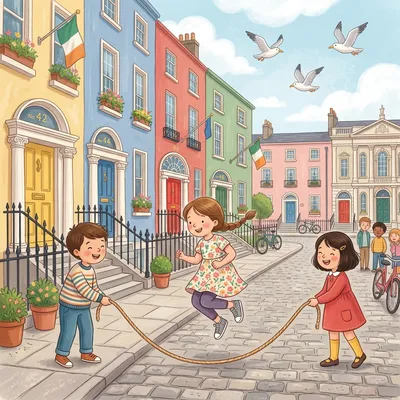
"Weile Weile Waila" is a Dublin street song, chanted by children skipping and playing in the city's roads and schoolyards through the twentieth century. It descends from the ballad family known as "The Cruel Mother" (Child 20, Roud 9), in which a mother kills her newborn child. Only the opening verses are printed above. The middle of the street text sets out the killing in plain words and is not something this site will publish, so the page below explains what those verses do instead, and how a song like this ended up in the hands of children at all.
Origins
The Cruel Mother is old and it is widespread. Francis James Child collected more than a dozen variants for his English and Scottish Popular Ballads in the late nineteenth century, and the ballad has been recorded across England, Scotland and Ireland. In the older versions the woman is punished by the returning spirits of her children. The Dublin song drops that entirely. In its place come two policemen and a man, who knock at the door and take her off to jail. That single change, from supernatural judgement to a constable and a cell, shows how far the song had travelled from its parent.
No firm date exists for the Dublin version. There is no known early printing of the street text, and no collector's note that fixes when it passed into children's play. What is documented is that the song was in general currency in Dublin during the twentieth century, that it was especially popular among Irish Traveller children, and that it was well enough known by the 1960s for two of the decade's best known Irish groups to record it. The Clancy Brothers issued a version as "Wella Wallia" on Recorded Live in Ireland in 1965. The Dubliners recorded "Weile Waile" for their 1967 album A Drop of the Hard Stuff, with Ronnie Drew singing lead, and kept it in the set for decades. It was sung at Drew's funeral in 2008. Those two records carried a local playground song to listeners well outside Ireland, which is why most people who know it today know it as a folk-revival track rather than a game.
Dublin's street repertoire was gathered by collectors in the same period. Eilís Brady's All In! All In! set down the city's traditional children's street games with their rhymes and music, part of a wider effort to record play that was passing out of use as the streets themselves changed.
Meaning & Interpretation
The refrain is not language. "Weile weile waila" means nothing in English or in Irish. It is a string of vocables, sound kept for its rhythm long after any sense had gone out of it. The usual explanation traces it to the Middle English cry "wellaway", from Old English wa la wa, roughly "woe, alas, woe", a lament that turns up as a refrain line across the older ballads. If that reading is right, the nonsense at the centre of a skipping song is the fossil of a real cry of grief.
That process is the genuinely interesting thing here, and folklorists see it constantly. A ballad passes through enough mouths and enough decades and it wears smooth. Verses drop. The tune speeds up. The moral commentary goes first, because children have no use for it, and what is left is a bare sequence of events with a hard beat, which happens to be exactly what a turning rope needs. The story is not softened so much as flattened. Every line ends on the same two refrains, which makes the whole thing easy to memorise and easy to keep time to.
The subject is dark and there is no way around that. It is also true that most Dublin children who sang it were not thinking about the story at all. They were counting skips. Playground songs get chosen for their metre, and children take the words in as sound long before they take them in as meaning, if they ever do. The same is true of a great many rhymes that adults find alarming when they finally listen to the words.
Why are only the opening verses printed here?
The verses that follow describe the killing directly and in plain language, which is not appropriate for a family page. The two verses above give the tune, the refrain and the shape of the song, which is what the melody rests on. The rest of the narrative is summarised in the sections above: the woman is arrested by two policemen and a man, and taken to jail.
What does "weile weile waila" mean?
Nothing at all. It is a refrain made of vocables, syllables sung for sound and rhythm rather than sense. The standard explanation is that it descends from the Middle English lament "wellaway", from the Old English wa la wa, meaning something close to "woe, alas, woe". Refrain lines like that were common in old ballads and often survive in worn-down form long after singers stop understanding them.
Did The Dubliners write Weile Weile Waila?
No. They recorded it, and their 1967 version on A Drop of the Hard Stuff, sung by Ronnie Drew, is the one most people have heard. The song was already circulating among Dublin children well before that, and the Clancy Brothers had recorded their own version in 1965. Behind both sits the much older Cruel Mother ballad, which was being collected by folklorists in the nineteenth century.
Where is the River Saile?
It is in Dublin. The name is generally read as an anglicised form of the Irish word salach, meaning dirty, and is usually identified with the Poddle, a small river that ran for centuries as an open drain through the south of the city before it was culverted.
Related Nursery Rhymes






Lyrics from nurseryrhymes.info