
The King of France Went Up the Hill


Lyrics
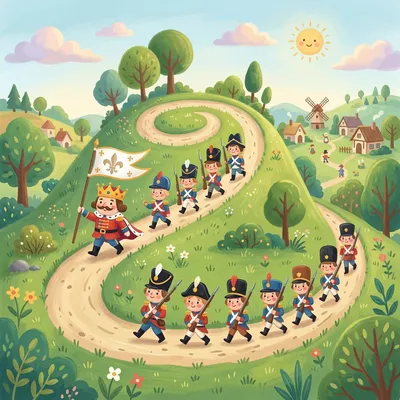
The King of France went up the hillWith twenty thousand men;The King of France came down the hill,And ne'er went up again.
History and Meaning
Twenty thousand men walk up a hill. Then they walk back down. Nothing happens in between, nobody fights anyone, and the rhyme stops. That is the entire story, and the flatness of it is the joke.
Most people meet this idea through Oh, The Grand Old Duke of York, where ten thousand men do exactly the same pointless climb. The King of France got there first. It is on record more than 150 years before the Duke of York rhyme appears, which makes the famous version the younger cousin rather than the original.
Origins
The earliest known printing is from 1642, in a short London tract called "Pigges Corantoe, or Newes from the North". There the verse is headed "Old Tarlton's Song", crediting it to Richard Tarlton, the comic actor who had died in 1588. That gap matters. The 1642 tract is the first actual record we have, but the title on it points back to the Elizabethan stage, so the rhyme is usually treated as older than its earliest printing rather than as a product of the 1640s. Whether Tarlton really wrote it cannot be checked, and the word "Old" in the heading suggests the song already felt dated to readers in 1642.
Richard Tarlton is worth knowing about on his own account. He was the most popular comedian in England in the 1580s, a member of the Queen's Men, and the jester Elizabeth I liked best. Contemporaries said he was the only person who could pull her out of a bad mood, and the only one permitted to tell her when she was wrong. He specialised in improvised comic verse, invented on the spot from subjects the audience shouted at him, and the style became so associated with him that such doggerel was called "Tarltons" for a while afterwards. He wrote and performed his own jigs, the short sung comic pieces staged after a play finished. He is generally thought to be behind Shakespeare's dead jester Yorick, and to have shaped the stage-yokel type that Bottom belongs to. A nursery rhyme carrying his name is a thin but real thread back to the Elizabethan playhouse.
A close relation survives in manuscript from the reign of Charles I, in MS Sloane 1489, where the couplet runs about the King of France and four thousand men who drew their swords and put them up again. Same gag, different arithmetic. The number of soldiers is unstable across the whole family of versions, appearing as four thousand, twenty thousand and forty thousand in different sources, and no particular French king is ever named.
Meaning & Interpretation
The rhyme mocks futile military effort. An army is raised, marched somewhere with great seriousness, and marched home again with nothing to show for it. The swords in the Sloane version are drawn and then sheathed without being used, which sharpens the same point. English audiences had plenty of continental campaigns to be sour about, and an anonymous French king made a safe target.
Both this rhyme and the Duke of York belong to a small tradition of songs that laugh at pointless marching. The structure is identical: up, down, and back where you started. That shape is also why the Duke of York version turned into a nursery action game, since children can stand up and sit down on cue. The King of France never picked up the actions, so it stayed a spoken four-liner and slowly lost ground to its livelier descendant.
Which came first, The King of France or The Grand Old Duke of York?
The King of France, by a wide margin. It was printed in 1642 and attributed to a performer who died in 1588. The Grand Old Duke of York is not recorded until the late 1700s, and the version naming a duke only settles into print in the nineteenth century. The marching-up-and-down joke was already old when the Duke inherited it.
Who was Richard Tarlton?
Richard Tarlton was an English actor and ballad writer who died on 3 September 1588. He was the leading clown of the Elizabethan stage, part of the Queen's Men company, and Elizabeth I's favourite jester. He was famous for improvising comic verse on audience suggestions and for the jigs he wrote and danced after performances.
Which King of France does the rhyme mean?
None in particular. No version names a king or a war, and no campaign has ever been matched to it convincingly. "The King of France" works as a generic figure of foreign authority, which is what makes the mockery safe and repeatable.
Related Nursery Rhymes




Lyrics from nurseryrhymes.info