
Old Mother Twitchett

Lyrics
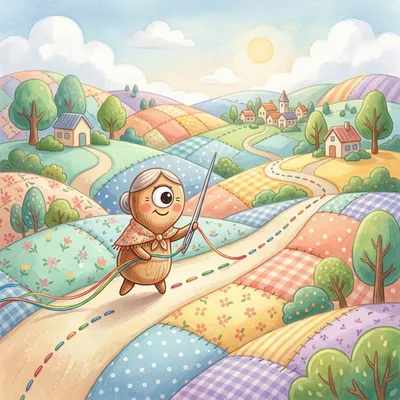
Old Mother Twitchett had but one eye,And a long tail which she let fly;And every time she went through a gap,She left a bit of her tail in a trap.
History and Meaning
Four lines, one old woman, no answer given. "Old Mother Twitchett" is a riddle rhyme, which means the verse is only half the thing. A child hears it, pictures something absurd, and then has to work backwards from the clues to the ordinary household object hiding inside them. The rhyme survives in nursery collections not because the picture is charming but because the puzzle is fair: every detail matches, and once you see the match you cannot unsee it.
Riddle rhymes like this one were a standard part of nursery books alongside lullabies and counting songs. They needed no equipment, no board and no pieces, just a voice and a listener, and they trained memory and reasoning at the same time. A child had to hold four lines in her head while turning them over. The riddles that lasted are the ones where the mapping is exact rather than arbitrary, where each clue does real work. The weak ones, the ones that depend on a pun nobody makes any more, dropped out of the books within a generation or two.
Origins
"Old Mother Twitchett" belongs to the traditional English riddle repertoire that fed into the Mother Goose collections. Riddles of this kind circulated orally long before anyone bothered to print them, and printed versions typically record a rhyme that was already old. No firm first printing has been established for this one, and the wording varies between books: some have her going "over a gap" rather than "through a gap", and the surname is sometimes spelled Twitchett and sometimes Twichett.
The name itself is a joke rather than a person. "Twitch" describes exactly what the object does in use, and dressing an inanimate thing up as a nosy old woman is one of the standard moves in English riddling. The same trick appears in Little Nancy Etticoat, where a candle becomes a girl in a white petticoat, and in In Marble Halls, where an egg is described as a fortress. Thirty White Horses works the other way round, turning teeth and gums into a scene of animals on a hillside.
Meaning & Interpretation
The rhyme is built as four clues in sequence, and each one narrows the field.
The single eye comes first, which is the strongest hint and also the most misleading, since a one-eyed creature sounds like a monster. The long tail "which she let fly" describes something trailing loose behind her as she moves. The gap is the third clue: she goes through it repeatedly, not once. And the last line explains the consequence, that a bit of the tail stays behind every time.
Put together, the picture is of something small that passes through a narrow opening again and again, dragging a long trailing thing, and shedding a little of it at each pass. Nothing living behaves that way. An object does.
The riddle rewards patience more than cleverness. Children who guess quickly usually guess an animal and get stuck on the last line, because animals do not leave bits of themselves behind on purpose. The moment the answer lands is the moment a listener stops thinking about creatures and starts thinking about things in the sewing basket.
What is the answer to the riddle?
A needle and thread. The one eye is the eye of the needle, the hole the thread passes through. The long tail is the thread itself, trailing loose behind the needle as it is pulled along. The gap is the fabric the needle pierces, and every time it passes through, a length of thread is left behind in the cloth. That is a stitch. Line by line, the mapping holds.
Why do so many nursery rhymes turn objects into people?
It makes the puzzle harder and the picture funnier at the same time. Calling a needle "Old Mother Twitchett" forces the listener to hold a false image in mind, which is the whole obstacle to be got past. It also makes the rhyme easy to remember, since a character with a name sticks in the head better than a description of a tool.
Are there other riddle rhymes like this one?
Several sit in the same tradition. Little Nancy Etticoat hides a burning candle, Thirty White Horses hides teeth, and Arthur O'Bower hides the wind. All of them describe an everyday thing in deliberately strange terms and then leave the listener to translate.
Related Nursery Rhymes


Lyrics from nurseryrhymes.info